17 November, 2026
Everything is in Everything: Panecastic Method and Border Pedagogy in the Architectures
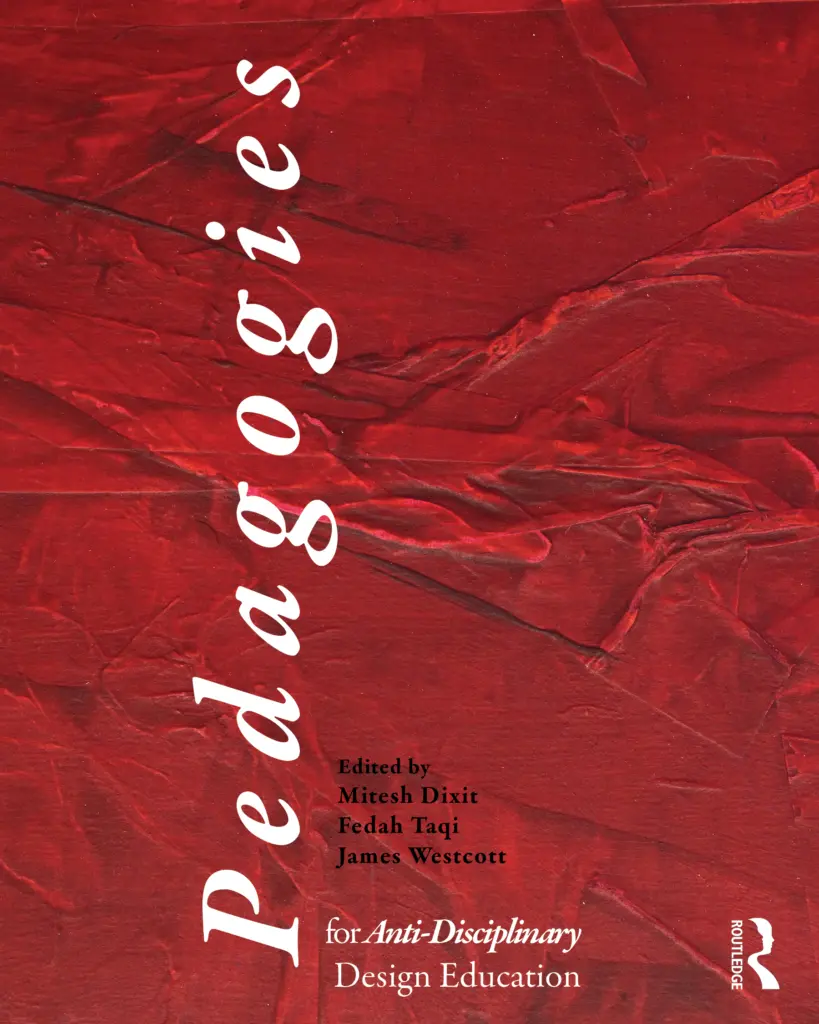
This is a recently published chapter in the book Pedagogies for Anti-Disciplinary Design Education, edited by Mitesh Dixit, Fedah Taqi, and James Westcott (Routledge, 2026). Here is the abstract and a short excerpt.
Abstract: Disciplines, professions, and canons are bounded, exclusionary, hierarchical models which, while they safeguard rigor and credibility, stifle broad inquiry across multiple subject areas and encourage solutionism. This chapter argues that academia requires questing modes of inquiry pitched toward readiness rather than planning. Models for this may be found in post- and anti- disciplinarity, border pedagogy, and the historic ideal of the panecastic method, developed by educator Joseph Jacotot in the early 1800s. Studio education in design offers some useful starting points to construct collaborative, cooperative, and emancipatory models for situated questioning and scenario-making, but is not enough in itself. A different ethical and epistemological framework for designing pedagogy – and universities themselves – is required. This may include not only the abolition of disciplines, but also of traditional degrees in architecture and landscape architecture.
Excerpt: “Panecastic Method”
A questing mode in education was defned in the early 1800s by the work of the visionary educator Joseph Jacotot, whose ideas were amplifed in Jacques Rancière’s magnifcent book The Ignorant Schoolmaster (1991). It weaves together his ideas with Jacotot’s such that the voices are intertwined. It is a cooperative work across centuries and through the imagination. In it, the traditional hierarchies of education, especially the master/student relationship, are presented as stultifying: “There is stultification whenever one intelligence is subordinated to another” (Rancière 1991, 13). Education, for Jacotot/Rancière, should be emancipating, and should be predicated on equality: not equality that is a guarantee or a precondition, but equality that must be practiced and verified, “a supposition to maintain in every circumstance” (Rancière 1991, 137–38). “To emancipate someone else, one must be emancipated oneself. One must know oneself to be a voyager of the mind, similar to all other voyagers: an intellectual subject participating in the power common to intellectual beings” (Rancière 1991, 33). Jacotot’s methods were born out of necessity. He found himself at mid-career in Leuven, then part of revolutionary France, teaching Flemish-speaking students, he himself spoke only French. With the help of a bilingual edition of François Fénelon’s utopian novel Télémaque, he and his students were able, through reading and speaking, to teach each other their languages (Rancière 1991, 1–2). Jacotot was able to make of this “a method for showing illiterate parents how they themselves could teach their children to read” (Ross 1991, vii), and further he framed a set of principles for education in general which he called panecastic method (from Gr. pan, everything, and bekastos each: everything in each), which “looks for the totality of human intelligence in each intellectual manifestation” (Rancière 1991, 39). Here are his principles, lightly paraphrased:
• All people have equal intelligence.
• Every person has the faculty of being able to instruct themselves.
• Everything is in everything (Jacotot 1991, n.p.).
While the first sounds naïve, I think it is intended as a grounding assumption that avoids prejudice from the outset. Everything being in everything then posits there is a route to everything through everything else, which is another assumption that allows questions for inquiry to emerge from any discipline and to lead to any other. I have long seen the study of landscape as a sneaky way of indulging in the study of everything while pretending to inhabit a discipline. This principle both rings true and is borne out in practice, particularly as a strategy for avoiding what Rob Holmes calls “landscape solutionism.” He builds on the definition proposed by Evgeny Morozov (2013) for solutionism in technology as “an intellectual pathology that defines problems on the basis of one’s capacity for solving them” and which sees complex social situations and social concerns such as public health or education simply as problems (Holmes 2020, n.p.). Landscape solutionism extends beyond social situations to include all the additional aspects of landscape as milieu. In it, this pathology manifests in three interlocking ways. First, solutionists ignore the many aspects of landscapes that are ecologically or socially important but are not problems. Second, when they find something that looks like a problem, they reach for known solutions, which may not fit the context. … And third, they avoid engaging with unsolvable problems, or, worse, mis-categorize them as solvable, producing cascades of unintended consequences. (Holmes 2020, n.p.) In landscapes, everything is in everything. Questions of society and culture are bound up in plants and soil and place and much more. Tug on one thread, and the others all move too – cascades of unintended consequences. Scenario-making is a key method proposed to circumvent narrow solutionism, and from a position that doesn’t assume mastery, which Holmes calls epistemic humility. Scenarios, approached with humility, allow the assessment of multiple possible future interactions. “Scenarios do not predict the future, but they can illuminate pathways by which divergent futures might come into being” (Holmes 2020, n.p.). Scenarios, like the maintenance of equality in education, are also suppositions that demand maintenance and verification – a constant checking between all participants and a constant re-examining of relationships, processes, forces, threats, and potentials. Scenario-making is a work of collective knowledge and collective imagination that is best served by an ecology of practice which, in the case of landscape and the built environment, is place-specific.
References:
Holmes, Rob. 2020. “The Problem with Solutions.” Places. https://doi.org/10.22269/200714.
“Joseph Jacotot.” 1911. Encyclopedia Britannica. 11th ed. https://en.wikisource.org/wiki/1911_Encyclop%C3%A6dia_Britannica/Jacotot,_Joseph.
Morozov, Evgeny. 2013. To Save Everything, Click Here: The Folly of Technological Solutionism. PublicAffairs.
Rancière, Jacques. 1991. The Ignorant Schoolmaster: Five Lessons in Intellectual Emancipation. Translated by Kristin Ross. Stanford University Press.
Ross, Kristin. 1991. “Translator’s Introduction.” In The Ignorant Schoolmaster: Five Lessons in Intellectual Emancipation, by Jacques Rancière. Translated by Kristin Ross. Stanford University Press.