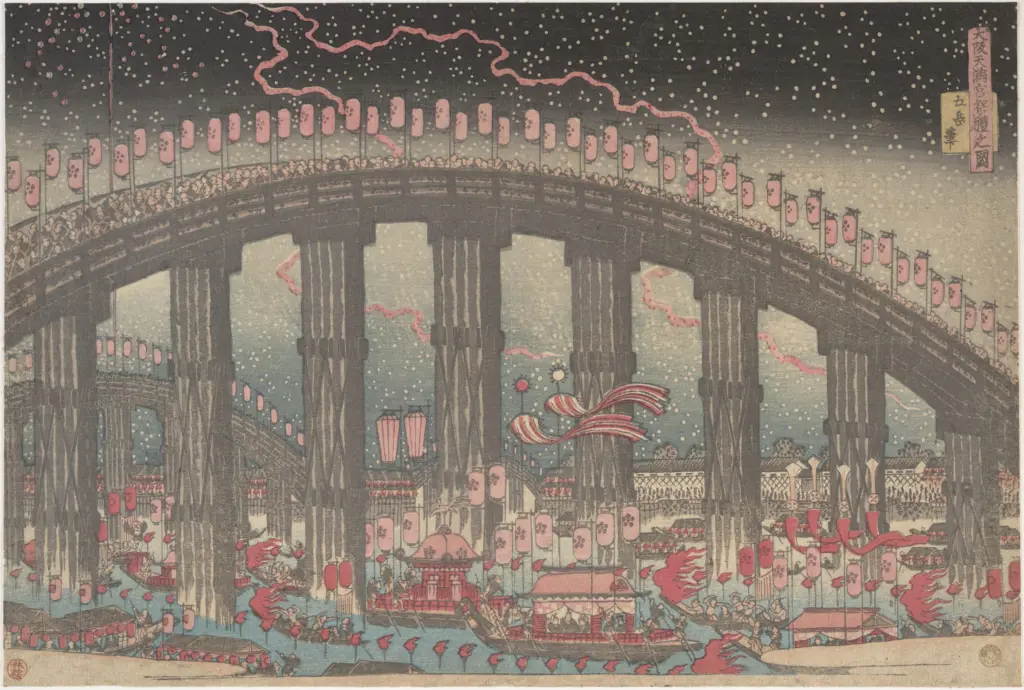
Yashima Gakutei, "The Tenmangu Festival at Osaka". Woodblock print, Japan, 1834. Metropolitan Museum of Art. Public Domain.
2 October, 2026
The Flow of Pleasure
Here is a short piece I wrote about pleasure as a foundational ethical value. It was intended for a collection on the theme of “Flow” but my contribution was too weird for it. Anyway, now you can enjoy my weirdness here instead.
Nothing flows like pleasure. Billions of litres of it can flood through a room filled with music, laughter, or ardent kissing, and barely form a ripple though its current is racing. Joy in its liquid form can also form waves and whitewater. It intensifies, condenses, and buffets time when it is eustress. This is the opposite of distress, but in both cases nerves are excited to extremes. The exhilaration of a roller-coaster ride is eustress—stressful and fun. Nothing, perhaps, has been so dammed and staunched and bottled in history as pleasure, but somehow it finds a way to flow around every obstacle. What’s that wet spot? Where’s the leak? Oh my, it’s a flood! We will be carried away!
To abandon oneself to the flood is often seen as the greatest transgression. A surrender to pleasure is seen as weakness. One must bear up under duress. Life is arduous and its reward is to be satisfied by having endured it. The radical pursuit of pleasure is an act of defence against the forces that seek to quell its flow. In that perceived weakness is hidden the greatest human strength. The pursuit of pleasure is a conscious drive to be in a sensing body inhabiting the world: to touch, smell, taste, hear, and see, and to do so well and fully. To insist on the fullest use of the sensorium is simultaneously to require a world that is delicious to the senses, and not just in Valhalla, but everywhere and for everyone, because well-being is mutual wealth, something to be shared as widely as possible. Feeling good together is at the heart of a healthy world-building imaginary.
Pleasure is at the root of endless creativity, but it is by no means beholden to production. Days and years of endeavour, focussed work, can be expended growing flowers, writing songs, or discovering new sexual positions without for a moment contributing to GDP or flows of money and power. The sociologist Zygmunt Bauman writes of what he calls ‘liquid modernity’, and this is a useful way of describing our contemporary lifeworlds which combine the aesthetic forms of postmodernity with the socioeconomic drivers of neoliberalism. In liquid modernity power and money are defined by their ability to flow away. They are not rooted in substantive landscapes and the sensing bodies that inhabit them. Liquid modernity offers aesthetic diversion—look over there!—while the substance of everyday landscapes that could provide lasting satisfaction is sucked away, some inevitably siphoned off to Valhalla, but much disappearing down the pipes simply because drainage is a principle.
The pursuit of authentic pleasure has the potential not merely to focus people on making places and lives better for each other. It also embodies (and emplaces) a necessary mutual refusal. You will not staunch the flow of pleasure, drain our joy. It is here where we are, together. We will bathe in its stream. We will not let it flow away.