This piece was published in the 12th International Biennial of Landscape Architecture Barcelona Catalogue, and I will certainly be developing these themes and giving them the larger consideration they deserve in future.
Poetics is the theory of the structure and form of poetry. As a study, it is concerned with how poetry is made and the effects it produces in the reader. The study of meaning in poetry is complementary to this and is addressed through the study of interpretation called hermeneutics. It’s terribly difficult to separate the two from one another, and most criticism combines them. Landscape design is similar. It has structure and form, but it is also impossible to disentangle its parts from its many layers of meaning, whether cultural, social, historic, biological, climatic, or geological. What happens in a good poem, or indeed a good landscape, is a harmony of structure, form, and meaning which is more than the sum of its parts. The effects it produces in the reader or inhabitant are supererogatory, and this cultural surplus is called grace. Grace, here, is relieved of its burden of religious meaning so we can examine the capaciousness it provides in everyday life and everyday landscapes rather than in the realms of the divine—or perhaps it is to say the divine may also be assigned to Earthly rather than celestial realms.
Remediation is, as it sounds, the act of applying a remedy, finding a cure. In landscape architecture the term is commonly applied to landscapes which have suffered great wounds or ills, particularly postindustrial landscapes. The study of landscape aids us in developing a definition for remediation which might differ from a straightforward cure. Certainly, a landscape understanding militates against ‘solutionism’. Landscapes undergo continual change, which makes it a category error to speak of a simple ‘fix’. Climate change and biodiversity loss, further, reinforce this dynamic by accelerating the pace of landscape change beyond, in many cases, any biological capacity to self-heal. Remediation in landscape must be seen as a redirection of a site and its ecologies into a new, productive form of relative health. Regenerativity in design helps us to see this more clearly, as regenerative design addresses not merely a landscape’s sustainability or resilience, but rather how it may go above and beyond to contribute to healthy functions both inside and outside its boundaries. Regenerative design and remediation in landscape operate on the principle that change is a process requiring grace.
Landscapes, I always take great joy in saying, are buildings. Whether one is speaking of streetscapes, stately gardens, or the ways in which Indigenous Amazonians have gardened the rainforest for millennia, landscapes are places constructed by human hands, the human and more-than-human imagination, and the ability to picture a past and a future. In the West, the principles of Vitruvius inform the art and practice of building. Henry Wotton, in imperfect yet oft-quoted translation in his Elements of Architecture of 1624, writes “The end is to build well. Well building hath three conditions. Commoditie, Firmenes, and Delight.” Commodity, firmness, and delight, however, fail to fully capture the sense of the Latin employed by Vitruvius. His words for the same principles are utilitas, firmitas, and venustas. Utilitas connotes an older sense of the word commodity, perhaps not so freighted with commodity capitalism, though of course buildings are now also very much commodities in this reductive sense. Utilitas speaks of a building’s usefulness and utility. Does it fit the required programme? Does it do its job? Firmitas remains the most obvious. Buildings must provide durability, permanence, and trustworthiness. Venustas is the term most mangled in translation. As a corrective, many contemporary writers will apologise for the inadequacy of ‘delight’ and remark that it instead or also refers to beauty. Even this remains breathtakingly short of adequate. Venustas is a term which enlists all the qualities of the goddess Venus. Beauty and delight, to be sure, but also love, charm, luck, and grace.
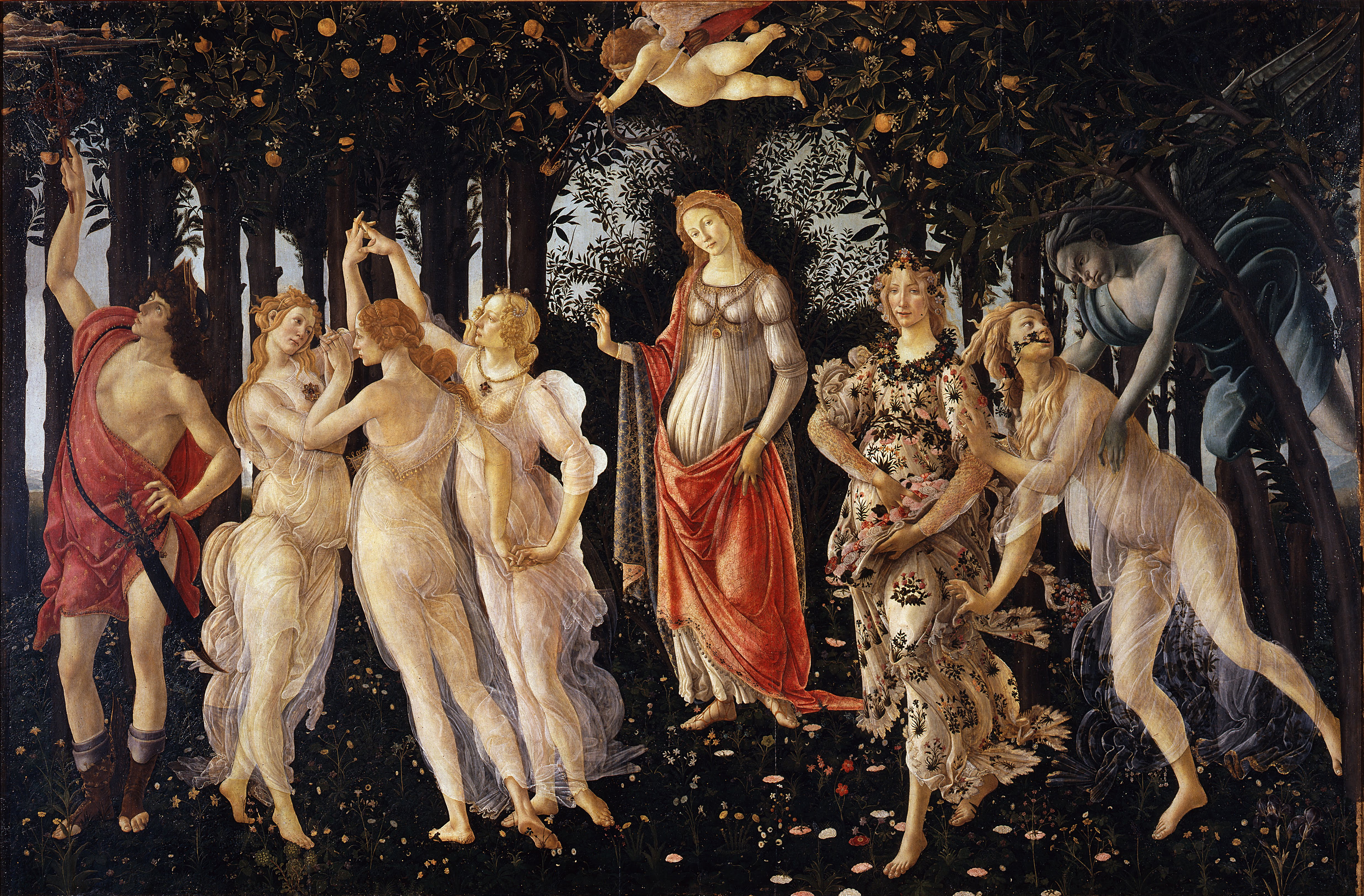
Primavera (c. 1482). Tempera on panel, 202 × 314 cm (80 × 124 in). Uffizi Gallery, Florence. Left to right: Mercury, the Three Graces, Venus, Flora, Chloris, Zephyrus.
Sandro Botticelli’s painting “Primavera”, painted in the late 15th century, remains enigmatic in many ways. Scholars often interpret it as an allegory of fertile nature, and indeed it pictures an astonishing number of individually recognisable flowers. I think I may not be too much misusing the painting’s meanings (and form and structure) to read into it those qualities of Venus, who stands in the painting’s centre. Above her is Cupid, who of course stands for love. To her right, the Three Graces are Voluptas (Pleasure), Castitas (Chastity), and Pulchritudo (Beauty). They symbolise a gift economy: giving, receiving, returning. Then an adolescent Mercury reminds that beauty is not solely a feminine quality (and it’s Chastity whose gaze is locked on him while Cupid’s arrow points also to her). To Venus’s far left is a more complex picture in which Chloris and Zephyrus gaze at one another. Zephyrus, the west wind, represents the changing season and the life-giving (and carnal) winds of Spring, and Chloris the nymph with whom he is infatuated. She is to become, through his attentions and some luck, Flora, the goddess of spring. Between her and Venus is her future self, Flora, or merely a personification of Spring (Primavera), who here provides a convenient allegory for gratitude to nature, a most crucial dimension of venustas for those of us in landscape.
The qualities of venustas, it’s clear are qualities important to buildings, but most particularly to landscapes. As earthly rather than divine qualities, too, it’s useful to apply these to the great stretches of time and great collective efforts that shape landscapes. In his preface to Understanding Ordinary Landscapes (1984), J.B. Jackson spoke some lines which have come to be immortal in landscape studies: “The older I grow and the longer I look at landscapes and seek to understand them, the more convinced I am that their beauty is not simply an aspect but their very essence and that that beauty derives from the human presence.” Here we see that rich entanglement of venustas in every humble, lived landscape. “The beauty that we see in the vernacular landscape,” he goes on to say, “is the image of our common humanity: hard work, stubborn hope, and mutual forbearance striving to be love. I believe that a landscape which makes these qualities manifest is one that can be called beautiful.” What’s beautifully evident, reading between these rich lines, is that everyday landscapes provide not just beauty, but something extra: a bit of wiggle-room, a whole collection of gifts from the past, from collective endeavour, and from nature. There is also an obligation to and care for the future which are aspects of grace and of gratitude. Grace is not merely something people receive, but something they are, in a gift economy, required to produce for others, human and otherwise. Our collective endeavour in everyday landscapes makes an abundance of space for beauty, delight, charm, luck, love, and grace.
Henri Lefebvre, in his Critique of Everyday Life (volume 1), in a delightful essay called “Notes Written One Sunday Afternoon in the French Countryside,” observes that the landscape is “slowly shaped by centuries of work, of patient, humble gestures. The result of these gestures, their totality, is what contains greatness.” This realisation is a manifestation of two of his key theories. The first of these is the oeuvre (work) which is the coming together of energies over deep time to create human lifeworlds—landscapes. The second is the moment. Among the various meanings of the Lefebvrian moment is an enriched, fulfilled sense of inhabiting a great continuum and a great work.
I like to tell a little story to relate how this sense of the moment operates. Imagine yourself standing in a strawberry patch. It is June, and the summer sun is gathering strength, which heats your neck. You bend down in that summer sun to pluck a strawberry from the cool shade of a leaf. As you raise the berry to your lips, its scent and succulence, its plump redness, its juices excite your senses and you are fully in a sensual moment. Further, though, what this moment recalls is the debt you owe to the strawberry species and all those who strove to improve it so you could experience the pleasure of tasting the berry on a June day. It also reminds you of your obligation to carry that pleasure into the future, and that you might also have some small role in that great work of making a delicious, fulfilled future for others.
I’ll end with a fragment of a poem, which sums up what it is to be part of such a moment, and also perhaps calls forth what it is to be engaged with landscape, which for those of us in design is a balance between the dazzle of design and the humility and grace which the scope of our topic imbues. Gloria Anzaldúa writes, in her poem “The New Speakers”,
We don’t want to be
Stars but parts
Of constellations.