Tim Waterman

Landscape Studies, Food Studies, Utopian Studies

Bad Role Models for Landscape Architecture

by Tim-Waterman on April 20, 2015, no comments

‘Bad Role Models for Landscape Architecture’ is a series of articles I wrote in 2012 for Landscape online and which led to much discussion (some angry) and a short appearance on the BBC where I criticised Charles Jencks’s earthwork Northumberlandia. Jencks believes that in a postmodern age any publicity, even negative, is good publicity. This, however, is only a very temporary fact, and work made for this type of media response will itself be as ephemeral. All six instalments are reproduced unmodified from the original as a single piece. 

Bad Role Models for Landscape Architecture

Many a landscape student’s bête noire is the concept – the ‘big idea’ that drives the design. Ultimately, any site’s big idea is its context and how that fits with its possible programme. Many design concepts actually prevent landscapes from functioning, and this series of short articles looks at a few of the ways projects can get off to false starts or come to bad ends.

Bad Concept Number 1: “The Inflexible Abstraction”
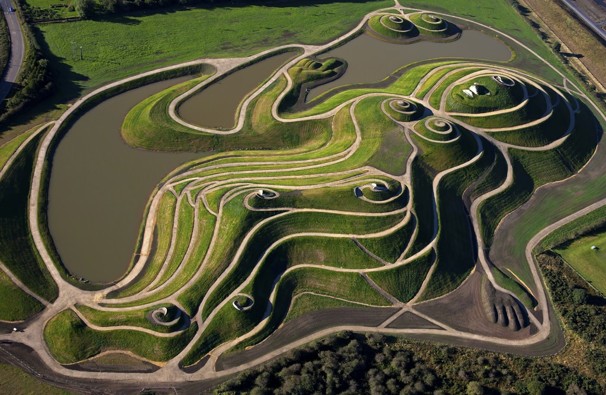
Northumberlandia, aerial view. From Strange History http://www.strangehistory.net/blog/wp-content/uploads/2013/01/northumberlandia.jpg

Northumberlandia, aerial view. From Strange History http://www.strangehistory.net/blog/wp-content/uploads/2013/01/northumberlandia.jpg

Gazing into the stars or pondering the philosophical ineffable can inspire us to try to express universal truths or fascinating theories about the nature of life or the stuff of the cosmos. This is a deeply human goal, but one that can go badly awry when applied literally to site design. Forms derived from speculations unrelated to site can die on the drafting table and then be delivered stiff and stillborn onto a site.

Charles Jencks is the current master of the inflexible abstraction and thus serves as our first bad role model for landscape architecture. Much work has been inspired by his curvaceous forms, which can be photogenic, but when students try to recreate his methods they find their designs are little more than cake-decorating across the surface of the site.

Indeed, this is usually what Jencks’s works do. His landforms strive towards a ‘universal iconography’ while expressing ‘local, national, and cosmic history’. This is accomplished by, for example, creating a pond in the shape of Scotland. The world is shrunk into a grain of sand as black holes commingle with quarks and Higgs’s bashful boson. Pages 20 and 21 of Jencks’ new book The Universe in the Landscape illustrate just how stiffly representational his work can be. A swirl of warped-grid paving curves into a massive concrete vortex. Visitors have been provided with a handrail so that they can resist the supergravity at the event horizon. Hang on tight!

Readers of Jencks’s new doorstop, should they be able to persevere beyond these initial pages, will be treated to a carnival of horrors, the most striking of which is an enormous landform in the shape of an earth goddess to be known as ‘Northumberlandia’, who, while not an actual local, national, or cosmic deity, is representative of one. She looks uncomfortable in her role. Northumberlandia’s hypertrophied breasts thrust into the sky while she lies in a twisted contraposto and raises a cold, dead hand in benediction. The icing on this particular piece of cake-decoration is that the artist saw fit to fashion an enormous mythic female form out of slag. Some day tourists will wave smugly from her hoar-frosted nipples.

A concept should give us a way of working with the landscape, not on the landscape. The projects illustrated in The Universe in the Landscape are models for concept-enslaved art imposed on the landscape, thus they are destructive models for landscape design.

Bad Concept Number 2: “All Soaped Up”

One World Trade Center. Image from Redesign Revolution http://www.redesignrevolution.com/wp-content/uploads/2012/06/One-World-Trade-Center-1.png

One World Trade Center. Image from Redesign Revolution http://www.redesignrevolution.com/wp-content/uploads/2012/06/One-World-Trade-Center-1.png

Sometimes the conceptual weakness in a design originates in the brief issued by the client, often when the goal is a “Garden of Something-or-other”. This could be ‘fellowship’ perhaps, or ‘remembrance’, or ‘earthly delights’. These are all meaningful appellations. They resonate with the public and the symbolic function of the language is fairly clear. They celebrate human ideals or human existence and they make these ideas tangible in a physical space that people can inhabit. These types of spaces have an important civic and cultural function for identity and belonging.

It can be difficult, though, to take such a far-reaching abstraction and apply it to generate form or to manipulate material on an actual site. These abstractions are as slippery as bars of soap. They just don’t afford any opportunities to get a grip

A spectacular example is Daniel Libeskind’s Ground Zero Master Plan for the World Trade Center site in Manhattan, the language of which is at once a haunted house of the ethereal and sacred, and a roundhouse punch of macho patriotic swagger. There are two key themes: one, ‘Reflecting Absence’, the twin fountains within the twin tower footprints and the ‘Freedom Tower’, the symbolic replacement for Minoru Yamasaki’s World Trade Center towers.

‘Reflecting Absence’, Michael Arad and Peter Walker’s fountains falter because they, in the manner of so many contemporary memorials, are immensely land-hungry. Since Maya Lin’s Vietnam War Memorial, every memorial must be narrative and immersive and big. Thus it gobbles up a lot of sacred land that could be used more usefully and very symbolically for the public exercise of democracy. Further, its fountains gobble up fossil fuels by pumping water at the rate of 98,000 litres a minute. This conspicuous waste combined with global tensions over fuel do nothing to improve the image of Americans in the world at large.

The pinnacle of the master plan is the ‘Freedom Tower’ (now the design of David Childs) and ‘freedom’ is used as both the conceptual and symbolic driver for the design. That anyone would want to utter the term ‘freedom’ after it was so wilfully perverted during the Bush years is remarkable, but Libeskind has given that perversion a patriotic erection 1,776 feet high (1776 being the year of the signing of the Declaration of Independence). For those many international dead from the twin towers, it is no comfort that this is, in metric, 541.3248 metres. Numerology is just another soapy, slippery notion.

Perhaps the important point for design, though, is that the concept of ‘freedom’ has burdened the world with yet another anodyne, air-conditioned, glassy, soap-slick stack.

Bad Concept Number 3: “The Killer Robot”
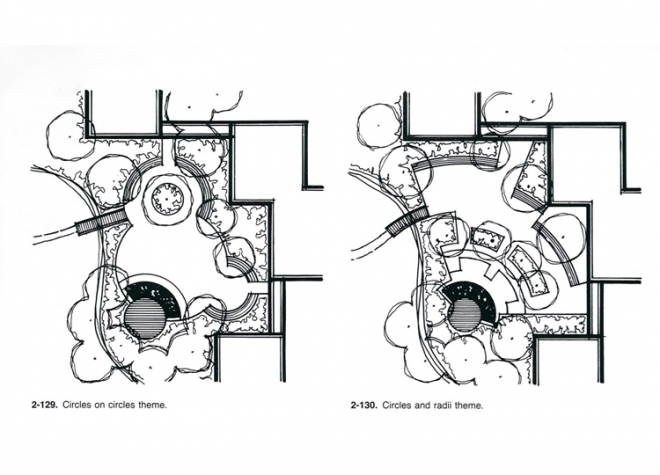
'Circles on circles theme' and 2-118 'Circles and radii theme' from Grant Reid's 'From Concept to Form in Landscape Design' (2nd Edition)

‘Circles on circles theme’ and 2-118 ‘Circles and radii theme’ from Grant Reid’s ‘From Concept to Form in Landscape Design’ (2nd Edition)

Wouldn’t it be wonderful if there was a simple formula for landscape design? Feed the site in as a variable (x marks the site), solve for x and, lo and behold, beyond the equals sign lurks a finished design. Actually, you’re probably thinking, it wouldn’t be wonderful. Landscape architects and garden designers would simply be out of work. Clients around the world could download the ‘garden design’ or ‘master plan’ app, and that would be that. Run app, print plan, hire contractor, job done.

On the Academy of Urbanism’s Linked In group, there have, at the time of this writing, been 106 earnest responses to the question “I am trying to develop a more systematic approach to assesing [sic] how well a place is doing …”, which shows just how much interest there is in the robotic, systematised approach to landscape. We know a simple formula doesn’t exist, but computerised modelling is still seen as a viable approach to landscape and urban practice, despite the egregious example of traffic planning’s universal failure to make better places anywhere through the use of very sexy and sophisticated models.

Models and formulas also demean our profession. The proliferation of short garden design courses based in a formulaic approach furthers the notion, dangerously amongst the general public, that a bit of careful shading with coloured pencil and the loving application of a bit of Euclidean geometry is all that’s required for place making. Landscape design: it’s just what you like, and just a bit of shrubbing it up. Child’s play. Why on earth would anyone spend eight years of their life working towards chartership just to do that? The prevalence of facile shape-making approaches in garden design has led a couple of generations of landscape architects to seek to distance themselves from gardens – a peculiar act that could be compared to denying the existence of your leg while you’re standing on it.

Not that this distancing has done much good. Formulaic approaches are writ large in a classic of the landscape architecture canon: Grant Reid’s From Concept to Form in Landscape Design.  Reid has now assimilated thousands of landscape designers into a colony of killer robots, manufacturing mindless, soulless geometric designs across the face of the Earth. There’s no denying that it’s easy. Begin with a circle (or a hexagon, or even an irregular polygon), click and place it around in CAD a bit, and presto, a garden design that functions only in plan and which stylistically evokes the golden year of 1985. Landscape design, as good practitioners know, happens in four, and probably more dimensions, and we must engage all of our senses in design that is spatial. The 2D plan drawing is not truly our friend, at least not when used in isolation, and certainly not when geometry alone is the driver for site design.

Bad Concept Number 4: “The Thing”
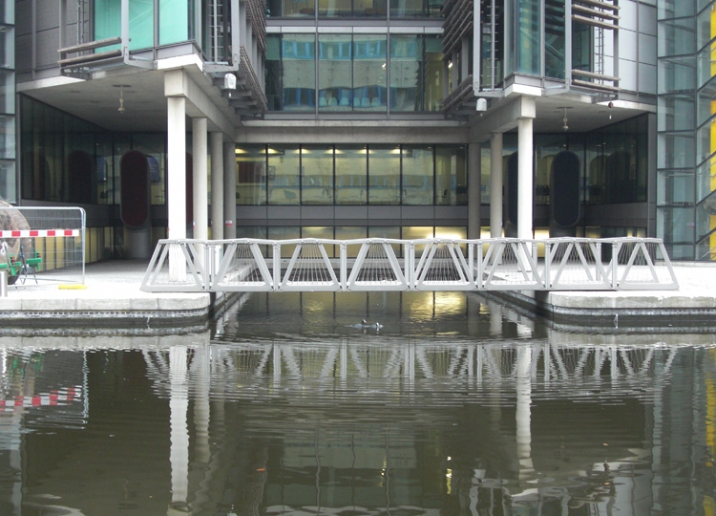
Heatherwick's Rolling Bridge at Paddington Basin. Photo by Author.

Heatherwick’s Rolling Bridge at Paddington Basin. Photo by Author.

A variety of factors, including the rampant economic growth around the turn of the millennium and the relentless drive towards branding that accompanied it, has led artists and designers of all stripes to seek continually to create the ‘iconic’ object. This is to some extent a noble ambition. It is possible to cast an eye back to globally significant examples such as the Wassily Chair, Tower Bridge, the Jaguar E-Type, Duchamp’s Fountain or Robert Capa’s Falling Soldier, to name a few, and to harbour some small ambition to duplicate that success. Naturally, many things will fall short of this significance, and that is a necessary evil. Many things become, in time, worthy of study as curiosities, aberrations, or bellwethers rather than icons. Damien Hirst’s For the Love of God or the revised Fiat Cinquecento might fit this category.

Icons, though, are rarely found in the work of landscape design. Landscape designers must beware of ‘the thing’: that object that appears fully formed on the drafting table and is then airlifted onto an unsuspecting site, where it becomes ‘plopitecture’. Worse yet, sometimes plopitecture necessitates a contortion of the site that appears posed and unnatural.

Thomas Heatherwick’s Rolling Bridge is one such egregious example. It is, in itself, a delightful thing. It is what all of our inner children want most: a clever and expensive toy. It sits across a small canal inlet that is grudgingly straddled by the hulk of Marks and Spencer’s HQ. Though Heatherwick Studio’s website is at pains to explain that the bridge lifts to allow access for a boat, a submerged concrete bulwark effectively obviates any such practice. And while one might imagine that such a clever and expensive portal might open to reveal a luxury stealth craft worthy of James Bond, the inlet is barely large enough to house a rubber dinghy. The awkward pose of it all renders the whole ensemble paltry, petty. One doesn’t want to play with either the toy or the box.

Roland Barthes, writing of photography in Camera Lucida, advances the theory that a photograph becomes effective through two means, the studium and the punctum. The studium might be seen as a sort of ground or setting, while the punctum (“that accident which pricks me …”) surprises and completes the image. The relation between sculptural objects or design elements and site might be thought of thus.

We should seek not to create icons, but rather, to use a good old-fashioned word, to create landmarks. A landmark is a punctum that is situated and that situates; it can make a place but it must necessarily be of that place and for that place as well.

Bad Concept Number 5: “The Gimmick”
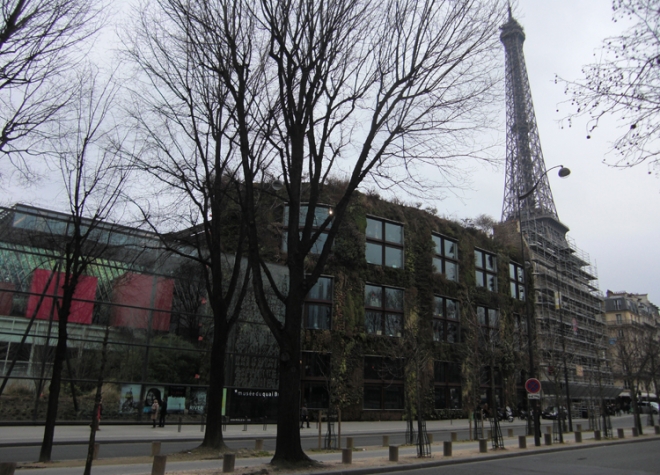
Musee du Quai Branly. Murky, unflattering photo supplied by author.

Musee du Quai Branly. Murky, unflattering photo supplied by author.

Our consumer culture continually reinforces obsessive neophilia. The next novelty, gadget, or technology is always enticingly within reach and there are whole realms of design in which obsolescence is a goal. There is a particularly loathsome breed of industrial designers, for example, who boast about the speed with which a product becomes obsolete and while still maintaining consumer confidence. Landscape architects are not immune to these forces, and often can design spaces that quickly become obsolete because they are dependent upon gimmickry and lack the ‘good bones’ necessary to endure beyond the life of the product. Failed lighting never fails to serve as a beacon of crapness, for example, particularly when the space is nothing but a vehicle for a spectacular lighting scheme.

Everyone likes a little flash and dazzle, though, and one designer who has cashed in on a gimmick is Patrick Blanc. With his green-dyed locks, leaf-print shirts, and long fingernails giving him a faintly reptilian air, he has stepped into the time-honoured role of ‘designer as exotic creature’. He clearly understands the theatre that is required for the job.

Blanc’s vertical gardens are the perfect combination of corporate bling and greenwash for clients who wish to project a literally and figuratively green image at the same time that they conspicuously display the ability to spend lavishly. No corporate campus food court is thus now complete without its own lush and dripping green wall.

There’s no doubt that people find these walls attractive. Last summer, Shelley Mosco designed a delightful Van Gogh styled vertical garden at the National Gallery that was nearly petted to death by adoring tourists and may have been the most photographed London attraction of the season. It’s only a matter of time, though, before the craze is over. Once the irrigation systems stop working those green façades will disappear, or, perhaps more appropriately they’ll just be planted up with ivy. Maybe, though, we will finally have accomplished the feat of convincing architects that vine-clad buildings can be lovely.

It isn’t that the gimmick isn’t important – it is – just as important as those Le Corbusier specs for giving the client the full experience of hiring a designer. These things, though, are just the trappings, which are prone to obsolescence. The underlying design must always be robust enough to remain beautiful and functional when the gimmick is gone.

Part 6: “Is There a Good Concept?”
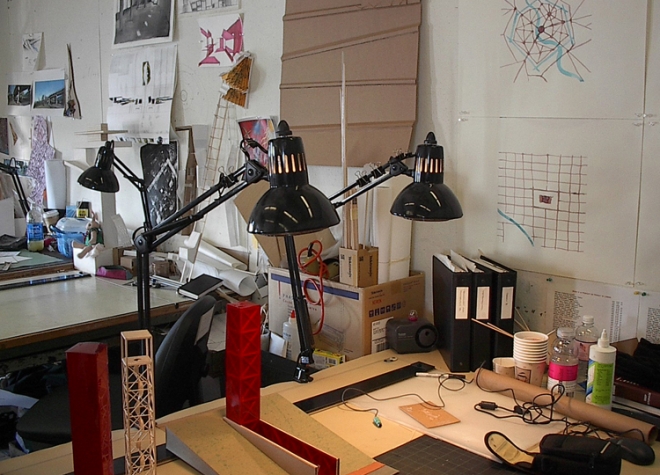
Design studio desk, early 21st Century, Rhode Island School of Design. Photo by author.

Design studio desk, early 21st Century, Rhode Island School of Design. Photo by author.

A large part of imagination is simulation. The design process can be thought of as a sophisticated ‘flight simulator’ that allows the testing of a design in motion before it takes form on site. A flight simulator saves lives, money, and materials by allowing novice pilots to err virtually – and this is precisely also true of design process. What of the art in design, though? A pilot learns skills that are analytical, instrumental, mechanical, whereas design must also be emotive, sensual, perhaps even mythic (and one wouldn’t want to be on a flight with those qualities). Is the concept the art component of design? Is design like a simulator run on the electricity of the idea? In a word, no. We need to reframe our idea of the idea in landscape design.

What is your concept?

This is the question that is asked in critiques, the question students and professionals ask each other, and it’s even the question clients have been trained to ask. The concept, though, as it is commonly wielded, possesses a monolithic singularity. Once formed, the concept can be unassailable. Mitigating factors and contingencies must be cast off or repelled. The concept becomes so abstracted from the site that communication between genius loci and concept is simply lost. The virtual aeroplane keeps landing on the same runway, same time, same crosswind, same stale coffee.

Where is the rupture? Why do concept-based approaches for design genesis fail? First, because they tend to be uncritical. Concept may follow analysis, but the crucial work of interpretation is missing. Second, because it is a human trait to seek abstractions that transcend the physical – often as pure, universal ‘truths’ – fixed and timeless, axiomatic. Concepts thus formed become so literal that they bear no relation to place. These two related tendencies result in art that more resembles taxidermy than living, breathing nature.

If not concept, then what?

We might begin to found a new idea of landscape design process by first examining the medium. It’s a truism, for example, to say that a potter thinks differently from a carpenter, that the medium of clay creates a particularly plastic mode of understanding, whereas wood has pliancy but requires precision, as does the woodworker. One might even, as an extreme example, examine Zen philosophy through the lens of the art of motorcycle maintenance. Our bodily experience of the world and our interaction with its materials shapes our life views and our modes of knowledge.

To examine medium in landscape design is particularly complex. First, there are the various media employed in drawing and modelling during the creative simulation phase of design that occurs in primarily in the studio. This plurality of materials marks a particular landscape architectural way of knowing that is distinct from the work of the specialist craftsman. Second, there is landscape itself, which really can’t be considered a singular medium at all, but rather must be viewed as a set of processes and forces – ecological, geological, political, social, cultural – that are constantly dynamic and interpenetrating.

The answer is, again, in our idea of the ‘big idea’ of design. If we conceive of both site and of design processes as fluid and relational, then we must begin to work and act in more fluid and relational ways. It is not a question of eliminating concept in favour of context. Context must be engaged through inaugurating a process of active, open-ended conceptualising in design as opposed to a fixed concept. This may seem like a subtle shift, but it is one that could not only utterly redefine our work with landscape, but redefine design processes across the architectures, arts and manufactures. As we seek more sustainable and resilient modes of thinking and practice, the scope of contemporary landscape architecture demands that we lead the way.
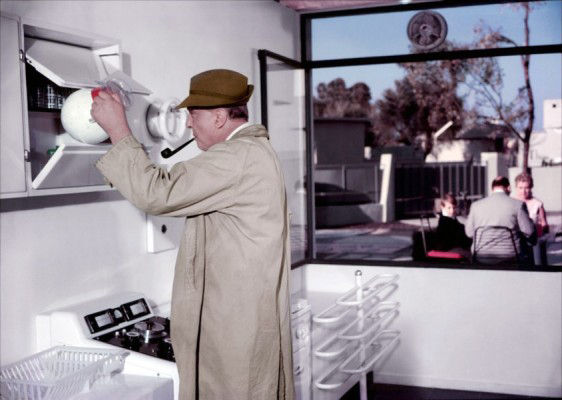
A Word… “Blang”

by Tim-Waterman on April 18, 2015, no comments

Burberry_pattern

Burberry check: the ur-blang, the ultimate in non-taste

“A Word …” is my quarterly column for Landscape: The Journal of the Landscape Institute. Here in the Spring 2015 issue I introduce the damning term ‘blang’ – where bland meets bling.

A pewter-grey luxury sedan is parked on a pea gravel drive edged with tightly-clipped shin-high boxwood hedges. A pedimented entryway, door gloss black and studded with plain but highly polished stainless knobs and furniture, is flanked by two Laurus nobilis lollipop standards in square galvanized containers top-dressed with slate chips. Here we see the full suburban expression of the phenomenon known as ‘blang’– bland meets bling – and we could be anywhere in the world, but the combination, neatly sidestepping any expression of taste either bad or good, is the clearest possible visual code for a particular type of wealth. This is the wealth that dares not speak its name, except in the most minutely read details –hand-burnished cordovan loafers, creamy tailored beige raincoats, polished granite, an indeterminate abstract canvas in earth tones and mauve, a spray of lilies.

It’s a form peculiar to a western middle-class and upper middle-class aversion to conspicuous display. Rarely are its symbols, which mumble instead of shouting about wealth, ironically appropriated by the subaltern classes as the trappings of wealth so often are, with the notable exception of the Burberry check (this is perhaps the ur-blang) and the Mercedes grille ornament as worn by rap artists in the 80’s and 90’s. The totems of luxury have always been subverted and parodied by those with the least disposable income, particularly the flashiest trappings that only the most spangled celebrities would dare to sport. Wear leopard and you’re either Paris Hilton, a punk, or a prostitute, though Paris is probably wearing a real skin rather than printed velour. Blang flies under the radar, avoiding any message at all except the hushed but urgent hint of money.

Our urban buildings and landscapes often used to unabashedly flaunt the wealth of our culture. Gaudy, yes, but the etymology of the word gaudy comes from an old English root meaning ‘joke’ or ‘plaything’, and our landscapes, city or country, were festooned with ornamental swags and statuesque symbolisms of all stripes. Our landscapes were playthings, fantasies, and they expressed good taste, bad taste, and wild, unprecedented taste. Just as often they expressed sensibilities that were decidedly local as well, as did buildings, such as those of Czech Cubism or Belgian Art Nouveau. With the exception of a few token eruptions of starchitecture, though, our cities are now becoming wastelands of tepid blang as the non-tastes of bankers and developers are expressed with international money by international practices on ever-larger sites.

The architectural critic Owen Hatherley, in his A Guide to the New Ruins of Great Britain, calls the prevailing style in architecture ‘pseudomodernism.’ Pseudomodernism, he says, is ‘Postmodernism’s incorporation of a Modernist formal language.’ It includes the usual headline grabbing one-off architectural spectacles, but also the anodyne faceted glass towers whose sole characteristic is bulk (Shard, World Trade Center One), a whole slew of anonymous buildings with barcode façades, and sleek, vaguely Scandi condominium and ‘luxury flat’ developments. It’s these last few categories that I would identify as blang, and landscape architecture in many places is doing its best to keep up with this vapid, meaningless style. The City of London’s landscaping, which years ago Pevsner (I think) described as ‘suburban,’ continues to live up to this accusation to this day, and all our other great cities are being shrubbed up to look like corporate campuses. We’re making places with all the charm and distinction of a business hotel near the airport. So the next time you’re worried that your design might be seen as bad taste, well, you could just be on to something. Don’t let that idea go! Wear a little leopard! Don’t give in to the blang! 

We Need Places Shaped by Local Interests to End the Housing Crisis

by Tim-Waterman on March 31, 2015, no comments

This post first appeared on Homes For Britain’s ‘Fifty Blogs in Fifty Days’ here

Peter Paul Rubens, Abundantia, c. 1630 [Public domain or Public domain], via Wikimedia Commons

Peter Paul Rubens, Abundantia, c. 1630 – She holds a cornucopia signifying prosperity, abundance, and the good life – all very different from the idea of austerity. [Public domain or Public domain], via Wikimedia Commons

Our housing crisis stems from a larger crisis in how we conceive of place and of landscape. Landscapes are the environments we shape and which, in turn, shape us. However, the control of our everyday landscapes – our cities and our countryside – have been turned over to be designed by placeless multinationals, giant developers, and (occasionally) architectural superstars whose work is global and could be anywhere. Then those horsemen of the apocalypse the FIRE sector (Finance, Insurance, and Real Estate) treat land and housing as financial instruments for speculation rather than as places that provide for human flourishing.

We need places, and thus housing, that are on the whole designed, funded, and developed locally so that cities are made in their own idiom and at a scale that suits them. The same is true of the countryside, where people need permanent housing – rather than weekend cottages – and good work so that they can live well and serve as stewards of the land.

The general panic resulting from austerity politics has fuelled a smug, elite project of asset-stripping the public good and the common wealth, including neighbourhoods and housing. We need its alternative: a prosperity politics that focuses on the best things possible for all people and the places in which they live. Quality housing, quality places, and meaningful work that provides demonstrably good things are essential to good quality of life and well-being. Indeed, they are essential to our planetary future.

At Liberty: Place de la République, Paris

by Tim-Waterman on January 22, 2015, no comments

This article is from the April 2014 issue of Landscape Architecture Magazine (LAM) and I have re-blogged it from The Dirt.

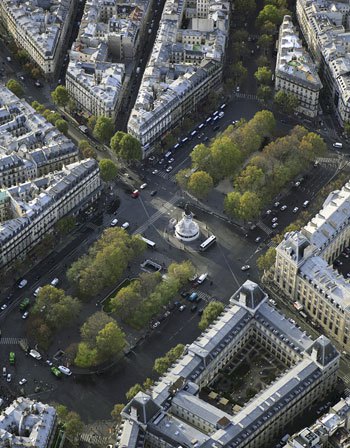
Place de la République before aerial view / © Air-Images.net

Place de la République before aerial view / © Air-Images.net

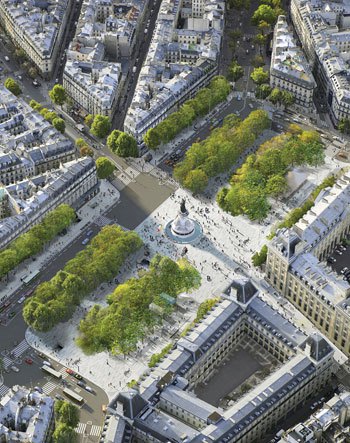
Place de la République after aerial view / © TVK

Place de la République after aerial view / © TVK

A piece of Paris has been recivilized for walking (or skating, or scootering, or protesting). Taxi Drivers aren’t happy, but they’ll get over it.

Over lunch at the cheap and cheerful Gai Moulin restaurant near the Pompidou in Paris, I spoke with the man at the next table about his experience of the Place de la République. He replied that it was outside his usual haunts, but that he had always seen the space as “a sort of absence.” This is precisely how I remembered the Place from previous trips to Paris. It was somehow dark, cold, and wet in every season; a vortex of angry traffic that made fugitives of pedestrians, a margin, a nonplace. What a pleasure, then, to return to find a space filled with warmth and activity even on a damp winter day.

The design, by the French architecture and urbanism practice Trévelo and Viger-Kohler (TVK) with Martha Schwartz Partners and the landscape architects AREAL, has brought the city back together where it had been fractured by traffic planners and years of small streetscape adjustments unaided by strategy. TVK was responsible for much of the design, the meetings, the consultations. One of the great successes of the space is owing to creative input from Martha Schwartz Partners: the partial pedestrianization of one side of the square. The other is owing to a very sophisticated grading strategy.

The Place de la République sits at the corner of the 3rd, 10th, and 11th arrondissements and at the center of a spiderweb of streets with no fewer than seven roads connecting (and more diving into forks just before). There are also five Métro lines that converge underground and eject people at five points around and within it. The square’s current shape is the result of the talented megalomaniac Georges-Eugène Haussmann’s interventions in the Second Empire. The construction of the square and the adjoining boulevards involved the destruction of a row of theaters on the Boulevard du Temple. One of the earliest known photographic images, a daguerreotype of the Boulevard du Temple, shows the area before Haussmann’s picks began to swing.

The center of the Place de la République is the top of a gentle hill on which sits a gaudy statue of Marianne, France’s national emblem, brandishing an olive branch with bombast. Before the renovations of the square she sat marooned on a traffic island, her pedestal covered with graffiti deposited during demonstrations. Now she floats over the dome of space, and the topography bends away from her and down the many radiating streets. The hilltop has been gently smoothed in every direction, which gives it a decisive tautness. It doesn’t have “hospital corners,” tucked into itself nicely as so many squares do; rather the tautness extends beyond the square and down each connecting street. As Schwartz says, “The project’s big win was to attach the square to the rest of the city.” The decisive, perhaps brutal, confidence of Haussmann’s avenues has met its complement. The square and the surrounding streets have all been joined in grand unity.

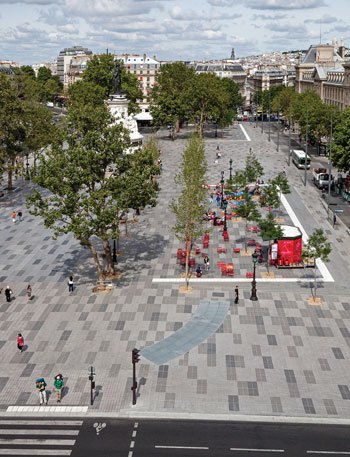
Place de la République / © Pierre-Yves Brunaud. Picturetank

Place de la République / © Pierre-Yves Brunaud. Picturetank

The redirection of the traffic, which partially pedestrianizes the northeastern side of the square, is almost a photocopy of London’s Trafalgar Square, which was also a choked gyre of traffic until Peter Heath, at Atkins, and Norman Foster, at Foster + Partners, corrected it in 2003. Whereas Trafalgar Square is completely pedestrianized along one side, its Parisian counterpart allows bus and taxi traffic along its quiet side. It’s hated by taxi drivers, who claim that there is now a permanent bottleneck at the Place de la République. The London version is not loved by taxi drivers either, nor by the National Gallery, which, with characteristic English reserve, claims the space is now so overrun with tourists that it has turned into an undignified carnival. In 2009 the gallery actually tried to have the traffic returned to the square.

The city of Paris is willing to wait out the taxi drivers, though. The intentions are overall to make Paris a place much friendlier to alternative transportation modes, and the hope is that congestion will ease as car usage declines. Paris also gives over automotive spaces to the pedestrians, bikes, and other wheels along the Seine during the summer when a beach appears on the road, and on Sundays all year.

On my midwinter visit the tourist throngs that plague Trafalgar Square weren’t in evidence at République, but the square was certainly thronged on my arrival. Thousands of Kurds and their supporters had turned out to protest the murder of three Kurdish activists in Paris the previous year. Flags of a variety of countries waved from the hands of young protesters who were climbing Marianne’s pedestal. Food vendors set up at the edges of the crowd, and then, lining every street in incredible numbers, there were armored gendarmes with their vehicles, drinking coffee and waiting for trouble (which never came). From my hotel room just next door we could hear the indignation of the crowds and the speakers coming in waves.

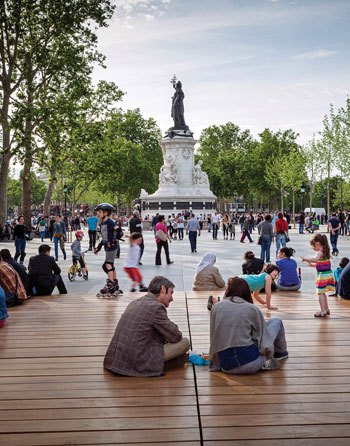
At midnight the square was full of piles of refuse being gathered together and trucks with pressure washers. A couple of flags still fluttered around the statue. The next morning, a Sunday, was clear and bright, and early on in the day the traffic around the square was light. With a cup of coffee and a croissant I watched the Place de la République awaken. First there were just a few of us—a couple of homeless people on a bench, the other coffee drinkers, a few people whizzing by on bicycles. Gradually, though, a wide variety of other types of wheeled vehicles began to appear, attracted by the large, clear, smooth space. First a father teaching his tiny son to ride his bike, then a mother and a young girl both with pink Rollerblades, and a toddler on a scooter who let it fall to the ground in order to have a good full-throated cry. Later, two girls with unicycles carefully threaded their way through a group having a kickabout with a soccer ball.

While I watched all the activity dependent upon a clear, level space, a delightful paradox became evident. The space does, as I’ve mentioned, slope off into streetscapes in every direction. It’s far from level. However, along the pedestrianized edge of the square, a series of four flights of stairs provides balconies over the space below and helps to give the illusion of levelness. Thus it is possible to stand in the square and simultaneously comprehend it as both meticulously level and pronouncedly domed. What’s even better is that this isn’t an accident. It required some very canny and careful grading. Not one of the flights of stairs meets the slope in the same way, and there are cross slopes to the cross slopes.

There’s a particular irony that Martha Schwartz Partners should have helped to design a space where the design work flies so low under the radar. Her practice is founded on her flair as a provocateur. She has always wished to move the landscape profession by exciting comment and provoking debate, and always with highly visible design overtures. “I am the army ant that sacrifices its body to build a bridge,” she says. She utterly rejects the old dogma within landscape architecture that it is at its best when it is invisible. I couldn’t help asking whether such a minimalist space was enough for her. No, of course not. If she had her way she would have swept the old plane trees away that guard one side of the space, replacing them with a series of big fountains. But it was not to be.

She explains the Place de la République’s subtlety in terms of the fabric of Paris itself. Paris doesn’t need landscape spaces that shock it back into functionality. It’s already working in so many ways, and so sure of itself. Paris, she says, “doesn’t need a defibrillator.” Still, one gets the sense she would have used one anyway if she could have. Maybe it doesn’t need it, but it can certainly take it.

There are also difficulties trying to make a design splash in a public space where so many people have ownership. “The public landscape is the most contested of all spaces,” Schwartz says. “It is where everything overlaps. It’s more political territory than it is environmental or social, for example.” In addition to the many stakeholders, how much can happen in a project depends upon the political will of the powers that be—whether they will take on risks, which may depend upon where they are in the electoral cycle. “TVK took the largest part of the project—they were sitting there with the politicians.”

It is the big moves that work here, and perhaps also all that work with the politicians. Other gestures are much less assured. The square’s simple austerity allows the warmth of human activity to fill the space. TVK seems to have become frightened of such minimalism and added to the square a small wooden stage at the southeast corner, but it looks paltry and tentative. Worse, the square is dotted with wooden benches, the outsized timbers of which seek to reference overstuffed sofas. These appear jokey and compensatory. Finally, the northwestern end of the square is held in place with a small rectangular café, grandly named the Monde and Médias Pavilion. Its glazed walls allow a seamless interaction with the surrounding space, and a roof cantilevers out over seating next to a water feature—perfect for parents wishing to watch their children. There is gently glowing lighting that adds a delicate ambience. From the water side, this is a successful ensemble, but viewed from the street side the café’s lines are far less confident. The floating effect of the cantilever doesn’t elevate the building here—it is decidedly grounded. The heavy beam that forms the cornice and counterbalances the cantilever overpowers the building with top-heaviness, and as an otherwise unadorned box the architecture offers no other tactic with which to counteract this effect. Viewed from the major approach down the Boulevard Saint-Martin across the busy street, it is a graceless and unwelcoming presence.

I leave Paris in the midafternoon and walk to the Gare du Nord to catch the Eurostar back to London. The southern expanse of the Place de la République is now filled with youths skateboarding, and the clatter of boards is so constant it sounds like the pop and crackle of a poorly tuned radio. To all the other wheels in the square I add the two of my suitcase. TVK created a beautiful bande dessinée graphic to convey the various programs and activities that were to be contained within the new Place de la République, and they’re all in there—the kids, the Kurds, the skateboards. Even the sullen taxi drivers might reluctantly find themselves in the mix.

Place de la République / © Pierre-Yves Brunaud. Picturetank

Place de la République / © Pierre-Yves Brunaud. Picturetank

So many of the groups that have ownership of the square have been there through the weekend. The grout is already coming away between the stones from all the pressure washing at night—a direct result of so much activity. It’s gone from being an urban margin to something that integrates the city around it, making it legible. The charming little cafés near the Square du Temple are now part of the same city that contains the tranquil Canal Saint-Martin, which, just on the other side of the Place de la République, dives into a tunnel through the same hill that is crowned by Marianne. What the graphic fails to show is that the site’s narratives aren’t contained here. They are now part of all of Paris’s trajectories again—they stretch outside, they connect, and they bring the whole place into focus again.

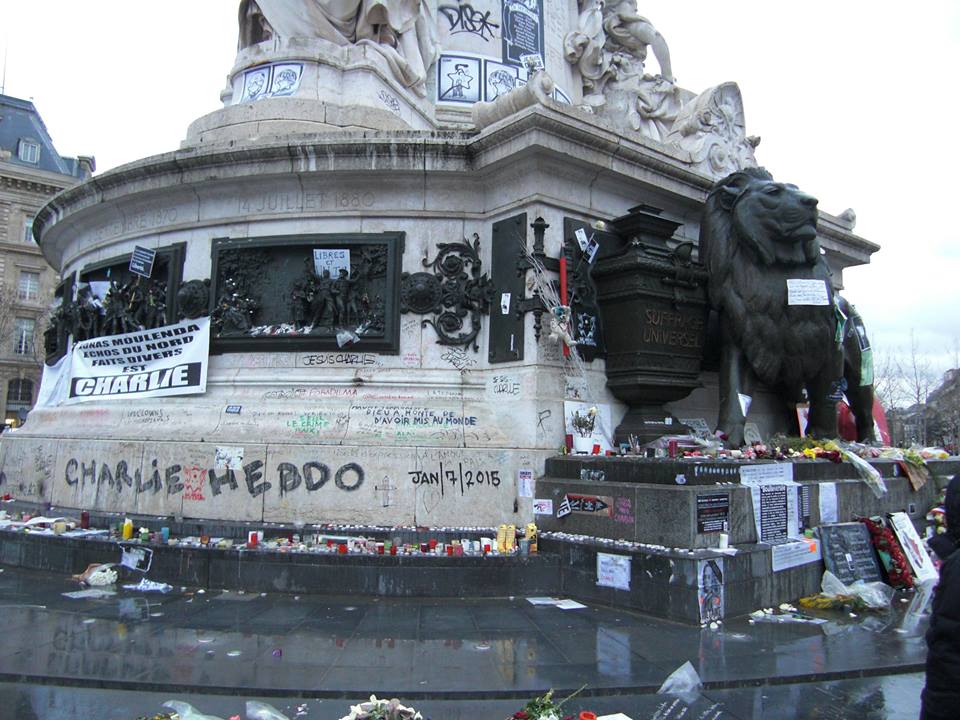
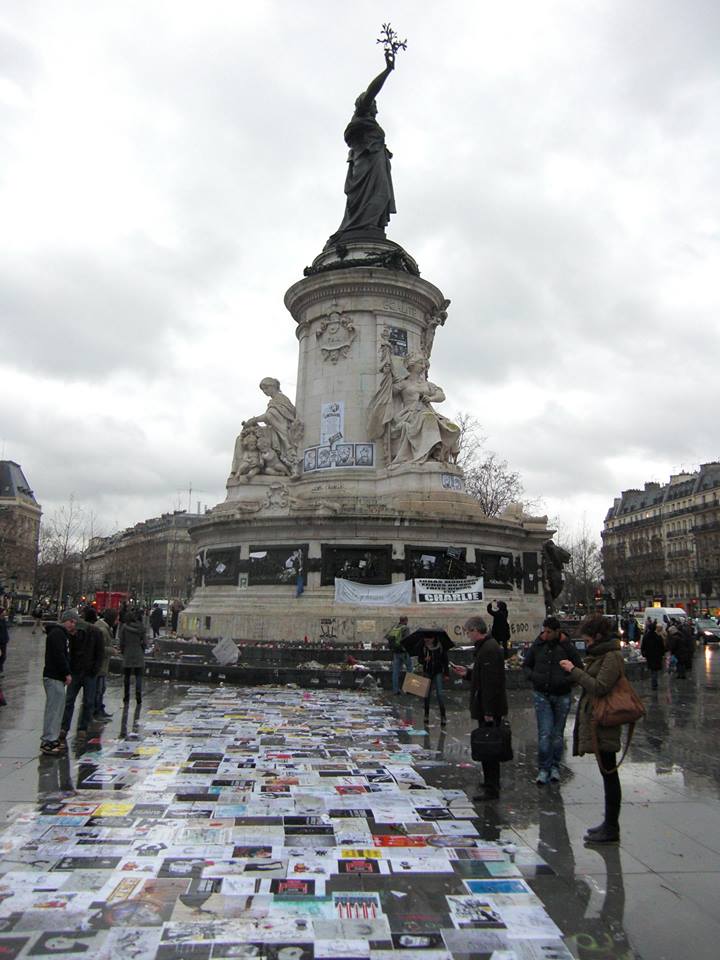
NB – I just visited Paris again recently with my partner in the aftermath of the Charlie Hebdo attacks. The Place de la République was clearly a focal point for public sentiment. 

Place de la République, 15 January 2015

Place de la République, 15 January 2015

Charlie Hebdo memorial and Marianne statue, Place de la République, 15 January 2015.

Charlie Hebdo memorial and Marianne statue, Place de la République, 15 January 2015.

Contextual Twentieth Century Architecture in Fitzrovia and Soho

by Tim-Waterman on January 14, 2015, no comments

Two remarkable buildings (at least) are scheduled for demolition in Fitzrovia and Soho, my neighbourhood. Their loss marks a failure to value the city as a collective work evolving over time and a failure to see buildings as part of urban social, cultural, aesthetic and even ecological context. London’s landscape will be further impoverished as a result.

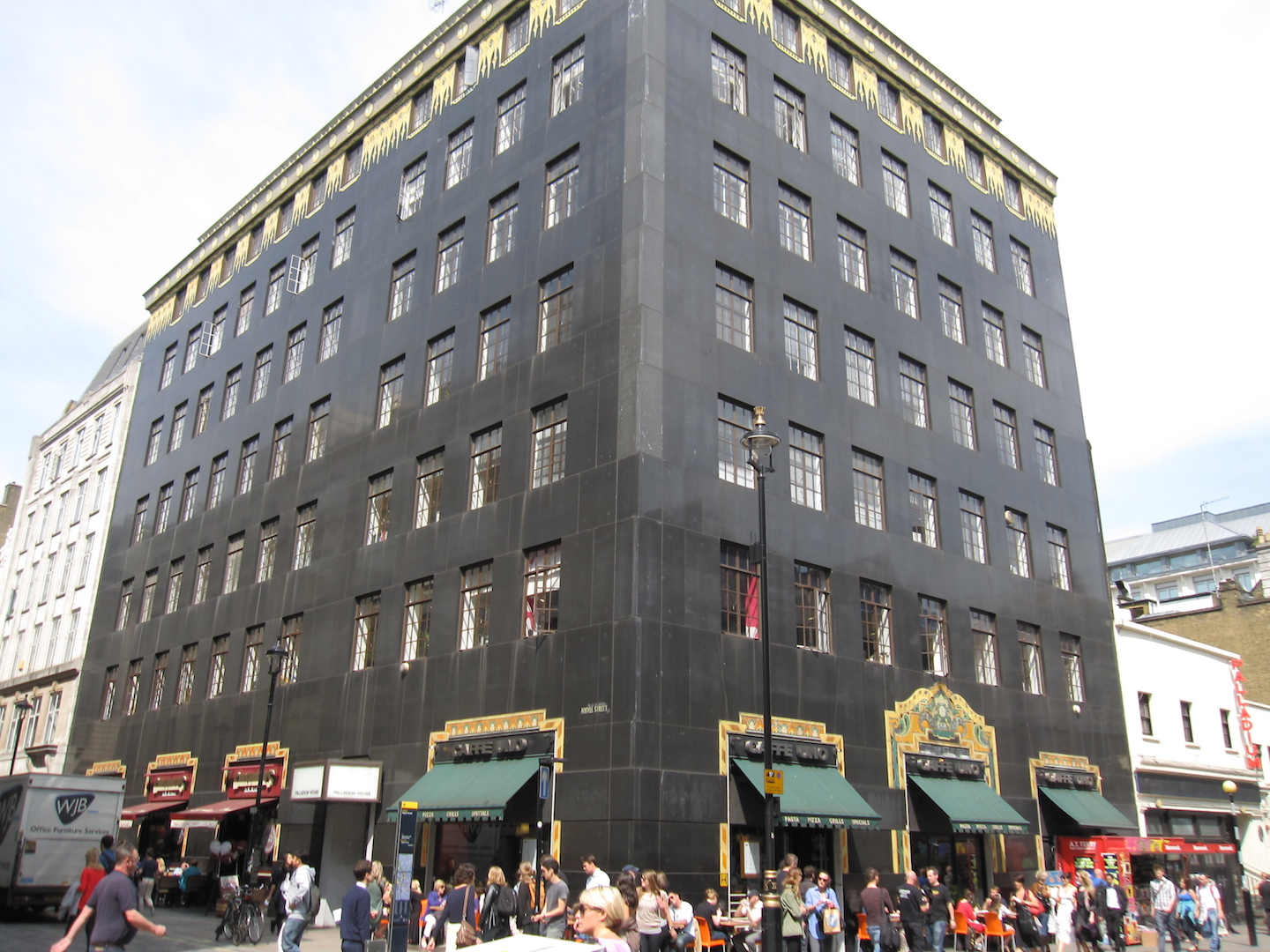
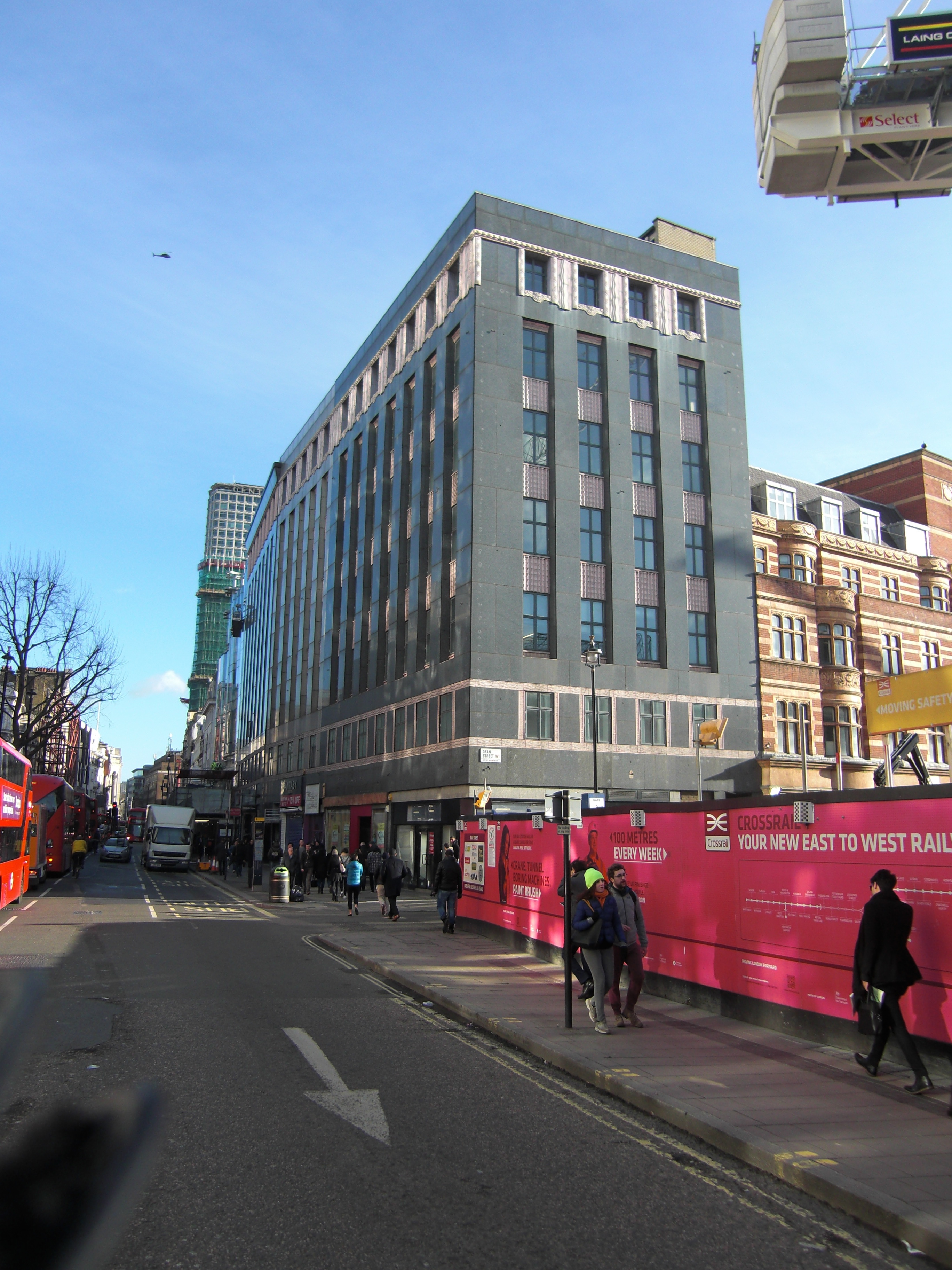
The first of these buildings is Richard Seifert’s Copyright House on Berners Street, just next to the pseudomodern atrocity that is Fitzroy Place, and the second is the art deco Drages Department Store at 68-89 Oxford Street, a bookend to the celebrated Ideal House on Great Marlborough Street. Though not as cleanly detailed and crisp as Ideal House, Drages epitomises the exuberant spirit of interwar commercial flash with its sculptural decoration in pink on gray. Drages is to be replaced by another leaden hunk of corporate architecture by Lifschutz Davidson Sandilands, wicked perpetrators of the execrable Fitzroy Place.

Last year I was interviewed in the Fitzrovia News about Copyright House, and I said the following:

“Fitzrovia is distinguished by a mix of buildings that have come to be cherished primarily because of their contribution to the lively but consistent scale and texture of its streets. Buildings of many eras, often designed with the élan and exuberance suited to a central location, provide both a record of each era’s aspirational aesthetics and a comforting assurance of continuity. Fitzrovia is one of the finest examples available that the city is a collective work of human endeavour over time,”

“Richard Seifert’s Copyright House, businesslike and muscular but with a touch of whimsy in its undulating canopy, is an important part of this cumulative work. Both its interiors and its exterior should be restored and maintained in this spirit. In particular its adjacency to the similarly important Sanderson building and other fine examples of contextual modernism in the area militate for its preservation as part of a local ensemble of twentieth century architecture.

“Sensitive restorations of other twentieth century buildings in Fitzrovia have helped maintain the area’s distinctive character. Development in an important area such as Fitzrovia should not fail to consider the contributions of twentieth century buildings and landscapes to its character and its value.”

It’s for too long been a lazy habit to see modernist architecture as buildings arrived from outer space on vast, cleared sites. This is perhaps more true of twenty-first century buildings than it ever was in the last century, particularly if one is looking about globally. Here are just a few of my very favourite examples of fine, contextual twentieth century architecture in my neighbourhood, taken from a quick virtual stroll around:

The Ideal House is located on Great Marlborough Street/Argyll Street, London, W1F 7TA. It was constructed in 1928-1929 by the architects Raymond Hood and Gordon Jeeves in the art deco style as the London headquarters of the American National Radiator Company. Image by Gryffindor, Wikimedia Commons

The Ideal House is located on Great Marlborough Street/Argyll Street, London, W1F 7TA. It was constructed in 1928-1929 by the architects Raymond Hood and Gordon Jeeves in the art deco style as the London headquarters of the American National Radiator Company. Image by Gryffindor, Wikimedia Commons

The incredibly confident and magnificent Ideal House on Great Marlborough Street and, below, its nearby art deco compatriot, the former Drages Department Store on Oxford Street. It’s so clearly both of and for its place; brash and beautiful, unabashedly capitalist bombast. Here is the Twentieth Century Society’s lament to its passing.

Drages Department Store, Oxford Street. Photo by author.

Drages Department Store, Oxford Street. Photo by author.

Incidentally, it is this bit of placeless, hamhanded blang (that’s bland + bling) by Lifschutz Davidson Sandilands that will replace it. Look how it squooges out over the buildings to its rear like a roll of sweaty, overheated real estate fat. And I’m sure it’s meant to meet the sky in homage to Seifert’s Centre Point, seen behind, but it comes off as parody more than homage.

73-89 Oxford Street as depicted on the website of Lifschutz Davidson Sandilands at http://www.lds-uk.com/projects/73-89-oxford-street

73-89 Oxford Street as depicted on the website of Lifschutz Davidson Sandilands at http://www.lds-uk.com/projects/73-89-oxford-street

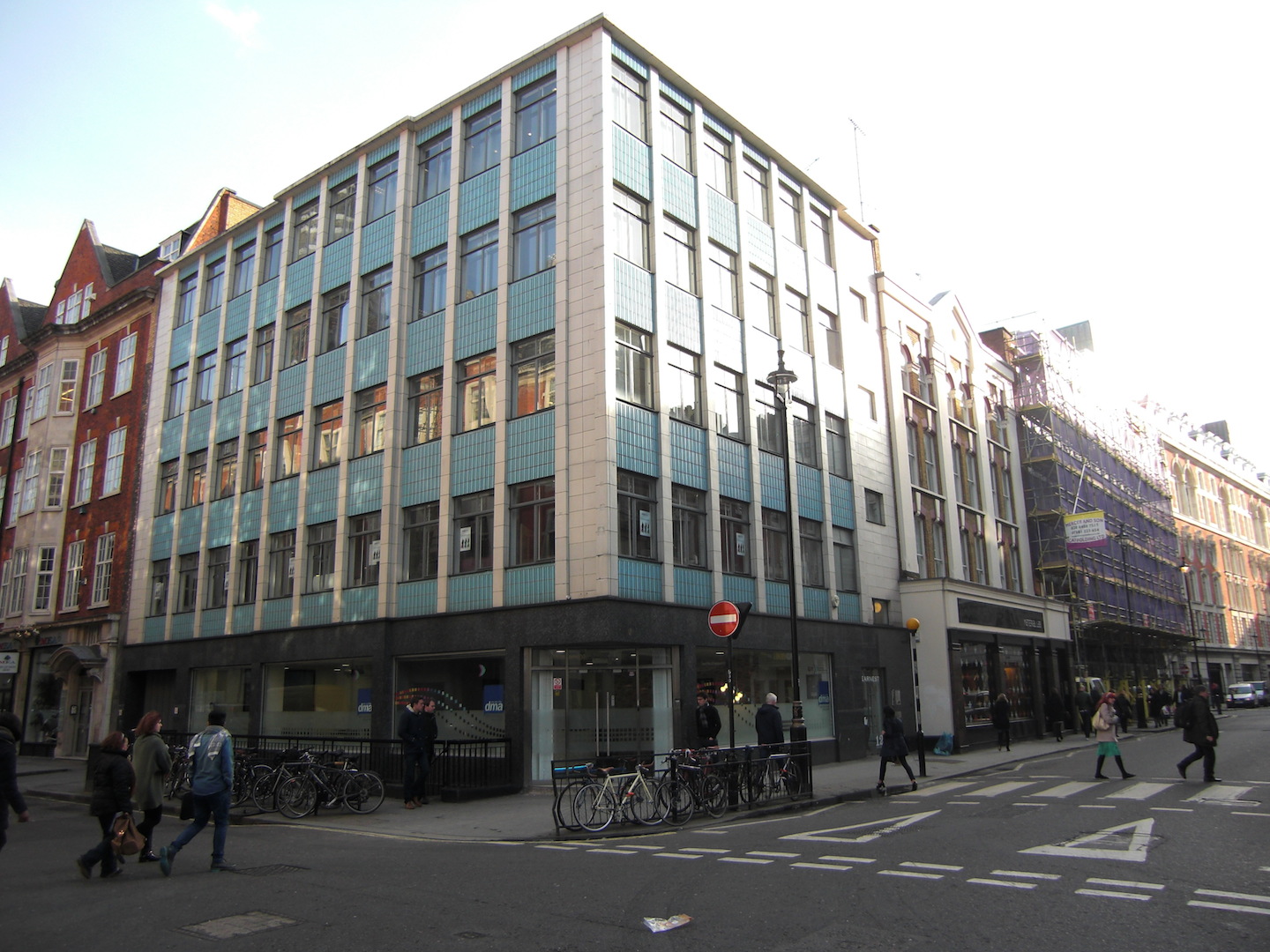
There are two of these light-hearted blue-spandreled buildings on Great Titchfield Street just off Market Square, and they never fail to fill my heart with joy. As contextual modernism, I’m sure they’re unlikely to become listed buildings by themselves, but surely they should be protected as part of the conservation area. This image doesn’t do justice to the colour, which is decidedly cheerful.

Buildings at the intersection of Great Titchfield Street and Margaret Street. The second is behind scaffolding at the moment (please let it not be demolition). Photo by author.

Buildings at the intersection of Great Titchfield Street and Margaret Street. The second is behind scaffolding at the moment (please let it not be demolition). Photo by author.

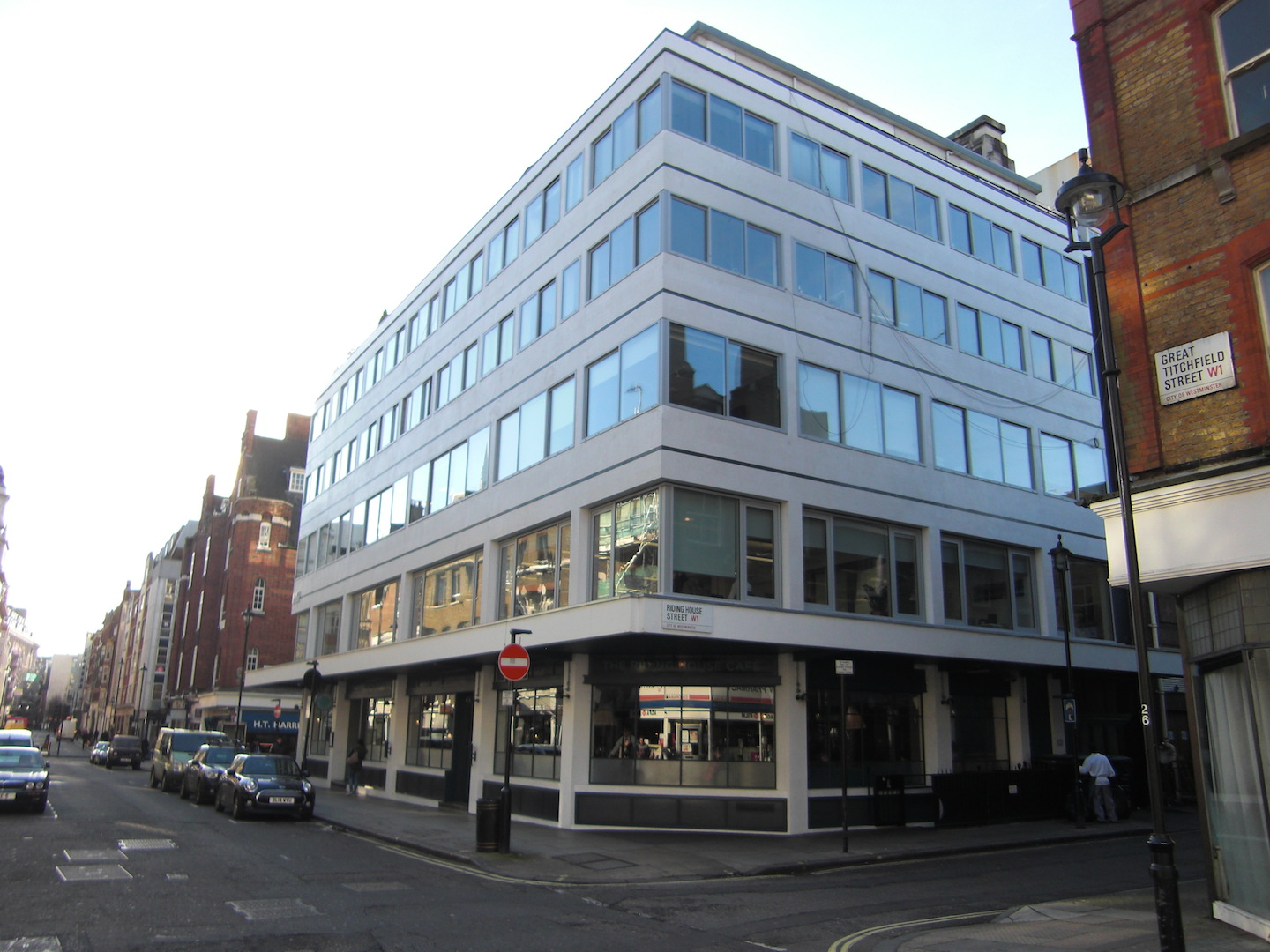
Further up Great Titchfield Street there stands this masterpiece of firmness and cosmopolitan grace. I was excited when the restaurant recently underwent a refurbishment, as I had visions of a Dudok-styled modernist café in the European idiom, but no, we got a pathetic bit of neo-Edwardianism with the same old subway tiles and exposed filament bulbs … and dead squirrels mounted by taxidermists as wall sconces.

Building at Riding House Street and Great Titchfield Street. Clean, elegant, contextual and crying out for a proper European café to be housed within. Photo by author.

Building at Riding House Street and Great Titchfield Street. Clean, elegant, contextual and crying out for a proper European café to be housed within. Photo by author.

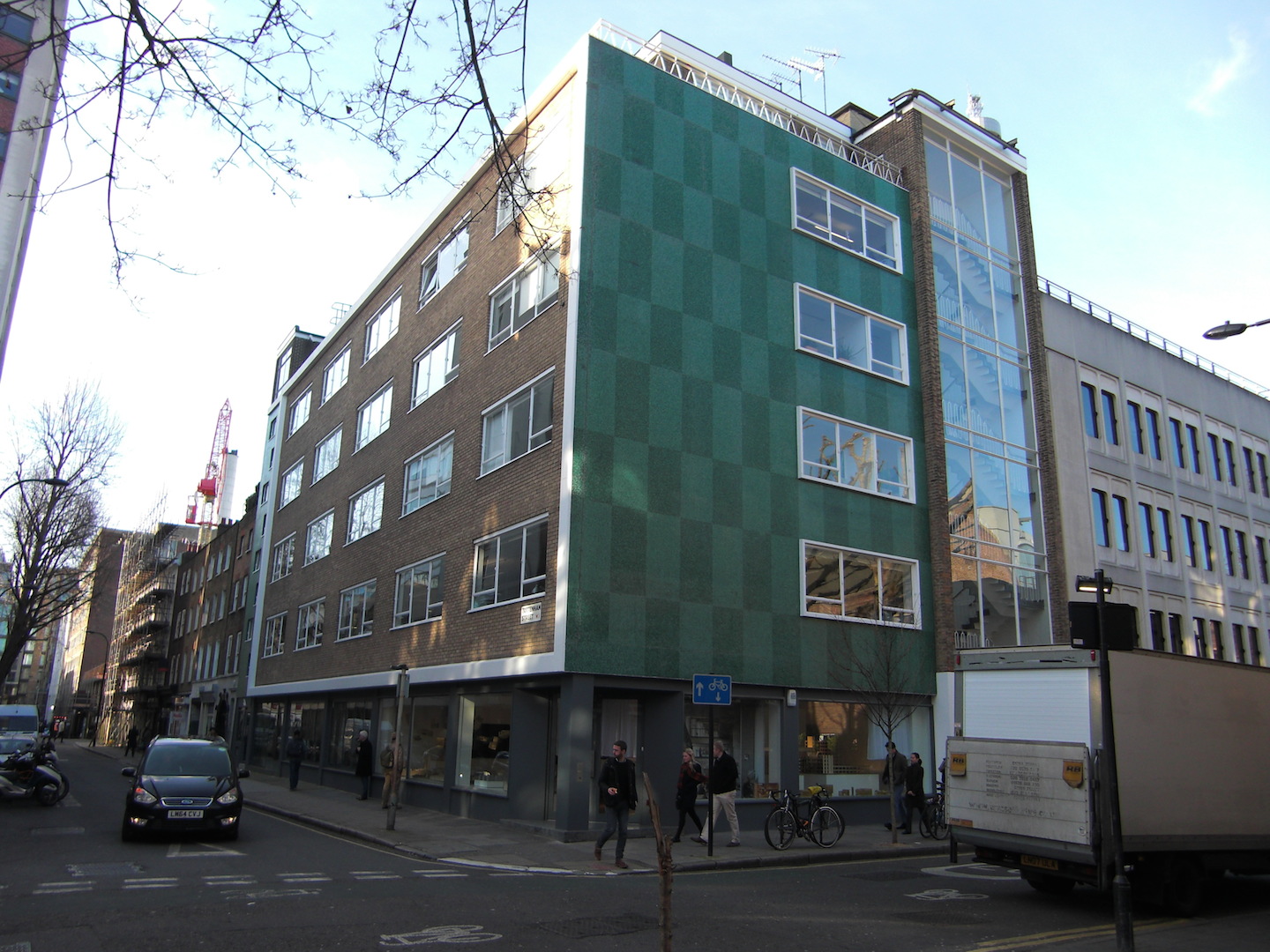
And then finally this beautiful building, on the northwest corner of Whitfield Street and Tottenham Street, which, to give credit where it is due, has been sensitively restored by the developer Derwent.

Building at Whitfield and Tottenham Streets in Fitzrovia. Such a fine staircase in a glazed shaft - sorry about the van in the foreground. Photo by author.

Building at Whitfield and Tottenham Streets in Fitzrovia. Such a fine staircase in a glazed shaft – sorry about the van in the foreground. Photo by author.

It is my fervent hope that eventually conservation areas might make better specific reference to good, contextual twentieth century architecture and landscape architecture, and preserve it as part of the ongoing work that is our beloved city.

San Francisco and Matthew Stadler’s “Landscape: Memory”

by Tim-Waterman on December 10, 2014, no comments

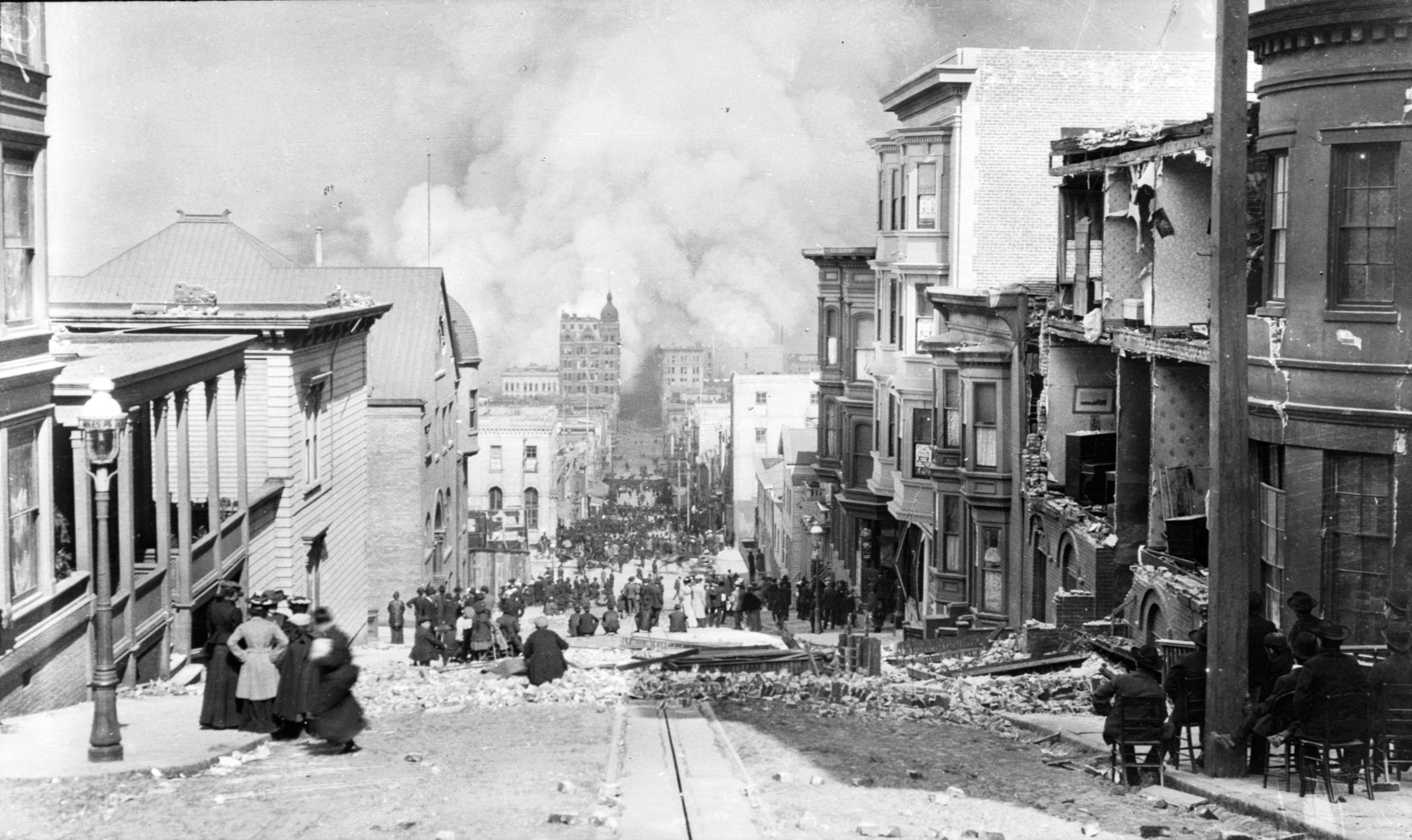
San Francisco fire after the 1906 earthquake, Sacramento Street, image by Arnold Genthe

San Francisco fire after the 1906 earthquake, Sacramento Street, image by Arnold Genthe

This is an unpublished essay I wrote in 2003. I have made some small changes for accuracy, but I have left my writing style of the time intact. I’m every bit as fond of Stadler’s book now as I was then. 

Literature provides a unique vehicle for the interpretation of landscapes, adding numerous senses to the experience described; a departure from standard non-fiction on the topic, which primarily concerns itself with the landscape as apprehended visually. The multi-sensory approach proves, if not more objective, a more faithful rendering of the way the individual experiences the environment. Further, it can help to point up the types of detail the subjective observer is drawn to, which could provide cues for design.

Matthew Stadler’s 1990 novel Landscape: Memory is an unusual, intelligent, and chatty coming-of-age novel set in San Francisco in the early twentieth century. Its setting, its lyrical use of the English language, and its precise detailing of the landscape of the time sets it apart from the average bildungsroman and makes it a most apt subject for the study of cultural geography and landscape. The novel also encompasses a wide range of landscapes, ranging from rural, pastoral, and seaside settings in Bolinas to bustling downtown San Francisco to the wedding-cake fantasy of the 1915 Panama Pacific World’s Fair; as well as a subplot located in the trenches of Belgium. The accelerating progress of the twentieth century is increasingly felt, but San Francisco has yet to explosively expand from its busy core into the surrounding countryside. Construction of the Fair may be viewed from the forest on the bluffs above, which are as yet unsullied by suburban homes.

The novel is narrated by its protagonist, Max Kosegarten, who while an astute observer, is prone to revery and flights of fancy. The narrative relates the story of his adolescence, punctuated with drawing lessons from Ruskin, ornithological excursions with his father, motoring with his anarchist friend Flora, the adulterous affair of his mother with his best friend’s father, and the budding romance between he and his best friend, Duncan. The story takes place in 1914 and 1915, during the building and opening of the World’s Fair, and with details of the great earthquake and fire of 1906 referred to in flashbacks. It’s appropriate that a coming-of-age story should be set at a time when San Francisco was experiencing the same sorts of growing pains; moving from urban adolescence to the full bloom of a world city.

The motion of the novel’s narrative is carried quite strongly by its physical movement through the landscape; each shift in voice, context, or plot is accompanied by a new setting that is lovingly described. The first pages set up the action with a description of the daredevil aviator Lincoln Beachey soaring above the Presidio in his fragile plane:

The wind is salty and cold in his nostrils, ripping in off the gray-green sea. It drags up the face of Mount Tam carrying sea birds who glide on its lift and pull, and birdmen, like Beachey, daring enough to take the free ride up on treacherous winds. This whole place is spread out wide below him. The yellow-blue waters of the bay, lying flat up to the lip of the land, the hills rising green, then brown and burned golden across the high ridges rolling on east and forever.

Imagine him south now. He’s come over the city, over the open green fields and thick woods of the Presidio, … down over Sunset and the dunes, south to the open hills running wild by the coast, thick fog pressing in on their western face. It’s rolling over the ridges and down into valleys, lying low and silent on the lakes.

The dunes, the waves, and the colours all seem to flash by in much the way an aviator must have seen them. This sets up both the overall context of the landscape in the book, and establishes the dream-like quality of San Francisco seen by a boy prone to flights of fancy. It also places the reader in time, with the visceral experience of flying in an early biplane, and the notable lack of development surrounding the city.

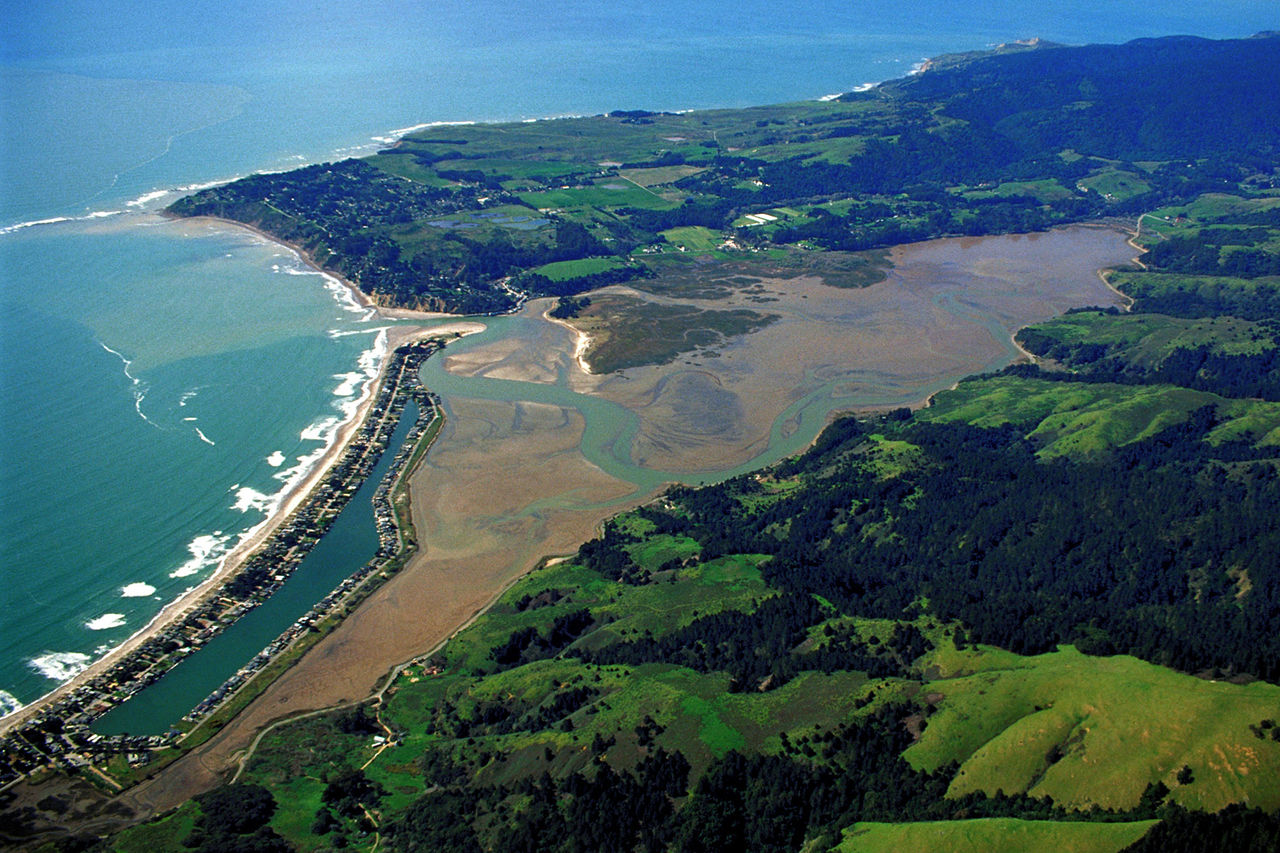
Aerial view of Bolinas Lagoon and peninsula, the setting for parts of Landscape: Memory. Image Army Corps of Engineers

Aerial view of Bolinas Lagoon and peninsula, the setting for parts of Landscape: Memory. Image Army Corps of Engineers

The narrative soon becomes more intimate, as Max and his friend Duncan explore the hills and gullies above Bolinas Lagoon, northwest along the coast from San Francisco.

We found a ruin to the south and back down into the thick woods of Weeks Gulch. Small and overgrown, barely one square room of tumbled-down stones, but a ruin nonetheless. It stood on a small rise up the north side of the gulch, peeling madronas bent high over the rough, crumbling walls. The view west opened up through the tops of redwoods growing from deep in the ravine. The hot sun had burned down all day on their broad green branches so the air was sweet and dry. The lagoon stretched out flat for miles, its lip lying on a muddy strip of land down beyond the mouth of the gully.

Once again, the semi-wild character of San Francisco’s outskirts is described, and this time with attention to the other senses. The feel of the air and the sun, and the scent of redwoods are strongly evoked. Later in the day, Max and Duncan have set up camp, and he notes, “only the loons remain with us, still and perfect, floating in the absolute calm. Their small bodies bob in the strange dusk. They slip across the water. And their long, lowing song fills me, as full and enveloping as the sweet, cool evening.” Here the loons and their calls, and their gentle motion on the still water once again show the landscape animated. The progression from the hot sun of the day to the cool evening also illustrates beautifully the cycle of the day, that carries us from sleepy morning to the activity of the day, then again to sleepy evening. It is important to remember that our perception of our environment is experienced through the filter of our senses, which are differently tuned through the day, even as the sun casts a different light at different hours, and night has its own illuminations to which our diurnal character responds with a most pleasant lethargy.

George R. Lawrence, 1908: "San Francisco in ruins from Lawrence Captive Airship – 2000 feet [660 m] above San Francisco Bay – Overlooking waterfront. – Sunset over Golden Gate." Market Street leads directly away from Ferry Building tower, center foreground.

George R. Lawrence, 1908: “San Francisco in ruins from Lawrence Captive Airship – 2000 feet [660 m] above San Francisco Bay – Overlooking waterfront. – Sunset over Golden Gate.” Market Street leads directly away from Ferry Building tower, center foreground.

The metropolis exerts a completely different influence on the person than do the woods and fields. The delirium of constant activity, the blaze of lights at night, the jumble of cars (and in the novel’s era, of horses and carts), the hucksters, the hooligans, and the finely adorned; all of this works to confuse us, as they work against our natural cycles. Far from unpleasant, though, the city is like a drug; distorting our perceptions, attenuating the focus as at once one is saturated with the peripheral. Max writes;

We parked down by Stockton, in the midst of the busiest jumble. Trolleys clanged past four abreast. Horses and carts and cars and bicyclists wiggled in amongst the mayhem. It seemed some disaster had struck,, some terrible trembling from deep in the earth and this was the ensuing panic.

Ladies bustled into traffic, navigating boldly through the various conveyances, stopping to converse on thin islands of safety between lanes of traffic. One raised her little gloved hand and a jitney jammed its brakes and skidded to a stop nearby. Other cars swerved out behind into the trolley paths.

Earlier in the text he says, “The buildings seemed so incredibly tall, rising up on either side of Post like sheer canyon walls …. The inhuman speed and noise of the motorcar rattled through me. It worked inside me so I wanted to either sleep or throw up, the two seeming equally viable and, somehow, quite familiar.” We see the fascination in the clangor of the city and how its hubbub works upon the senses and emotions so that they become as cacophonous as the world around. In the latter quote we see, too, that this effect is simultaneously upsetting and calming; paradoxical, perhaps, but all too true, especially for those able to recall their first experience in the city.

The city’s hallucinogenic effect is yet magnified in times of crisis. In a flashback to his early childhood, Max recalls the catastrophic earthquake of 1906;

Nothing was familiar anymore. All up and down the street the houses were broken, fences fallen. I could see through places where before I couldn’t. Yards disappeared under rubble and the street did too, all tangled and blocked. Some places were big holes like one near me with metal pipes poking out into air and a horse’s head I could see reaching up out from the rim, wild-eyed, baring its teeth and foaming. It was on its side, fallen against the dirty wall of the hole, not using its legs right.

I walked away back into the play dunes where everything still looked okay and it was quieter if I got far enough in. I stayed there for a while. I couldn’t think much about things.

Sunken houses on Howard Street in 1906. Image from stereoscopic card.

Sunken houses on Howard Street in 1906. Image from stereoscopic card.

These phrases remind us that beneath the veneer of order lurks the possibility for disaster that exists in any landscape. While it may be unsettling to ponder this, it highlights the preciousness of the accustomed view with the intimation that it precariousness necessitates greater appreciation. This sensation is never more apparent than during a crisis, or most especially in times of war when we ourselves are the catastrophe being visited upon the land.

The Great War was in full swing during the time in which this novel is set, and reminders of it come in the novel in the form of letters from Max’s Uncle Maury, an English doctor and soldier in the trenches of Flanders. Throughout the book, the letters become more and more dour, until finally Maury describes curling up and succumbing to the numbness of the horror of war. He describes the landscape outside the trenches when he is assigned to scavenge salvage during a brief reprieve from the exchange of fire:

From a distance it looked plain enough, a sea of mud pocked by craters … There are no trees here, any longer, no shrubs or ground cover, no grass or wheat or rye, nothing. Good land is solid and the rest is mud, sometimes waist-deep and impossible to tell until you’re right in it. We’d been issued rakes and ropes for our operation. You can imagine the first find, my rake dragging into something heavy but manageable, the boot end coming up first and then it popping clean from the sucking mud just above the knee where it had been severed. One can be so willingly blind until slapped in the face, and then be blind again.

No Man's Land, Flanders, 1919.  Photo by W. L. King, Millersberg, Ohio; by courtesy of Military Intelligence Div., General Staff, U.S. Army.

No Man’s Land, Flanders, 1919. Photo by W. L. King, Millersberg, Ohio; by courtesy of Military Intelligence Div., General Staff, U.S. Army.

Just  as young Max witnessed the tearing apart of the earth during the earthquake in San Francisco, so his Uncle Maury is witness to the terror that can dwell just below the surface; literally, in both cases, though the figurative meaning is not far behind. Even in the midst of such terror, however, our trust in the power of the land to heal itself is manifest. Maury writes, “What sorts of birds should one expect with spring here? I find myself wondering about the reality this place once was. I don’t recognize it as land really … Perhaps the war’s a wound that will heal with the weather and the seasons.” Interestingly, I just traveled to Western Flanders near Diksmuide this winter, and even though the trees are grown and the fields are green and lush now, the spectre of the horror of war still hangs over the land in a most palpable way. As the title of the book suggests, memory is as distinct a part of the landscape as are the immediate senses. It makes the verdure seem but a thin pretense, a hasty excuse for the history buried in the soil.

San Francisco panorama after the earthquake of 1906. Lester C. Guernsey - Photo by Lester C. Guernsey Via Library of Congress Panoramic collection

San Francisco panorama after the earthquake of 1906. Lester C. Guernsey – Photo by Lester C. Guernsey Via Library of Congress Panoramic collection

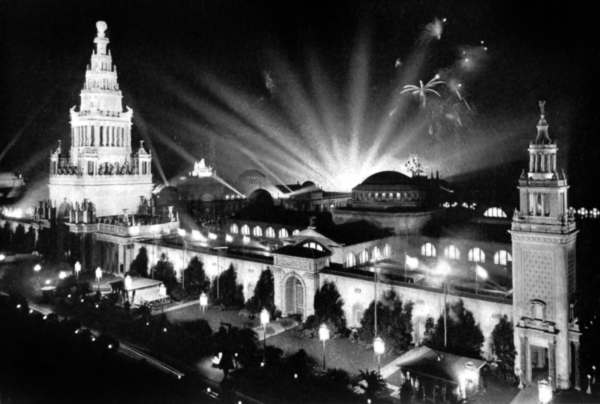
Opposite to the novel’s approach to the war those thousands of miles away is its focus on the euphoric, exalted landscape of fantasy that was the Panama-Pacific World’s Fair. Though marred by wartime boycotts, it was still very well attended, and was celebrated for its ‘Tower of Jewels,’ its ‘Palace of Fine Arts,’ its many hundreds of sculptures, and its dazzling display of ‘Scintillator’ lights.

The Fair opened up below, rising like a fantastic dream of the Orient, all golden, pink, red, orange and blue. The domes looked more unimaginably grand than ever they’d seemed from land. Thin pillars and minarets, the Tower of Jewels, like liquid silver, washed in the sun—from the Presidio clear across to the marina, they rose, sparkling in the brisk salty air. 

This is Max’s impression of the Fair as viewed from the ferry in the bay. Like the urban experience, and like the war experience, the Fair is larger-than-life, other-worldly, and hallucinogenic. This was a landscape of dreams, of the greatest aspirations of human imagining, and just like a dream it was insubstantial. The great buildings and colonnades were mere wood and lath and plaster, painted to mimic the massiveness of stone; the sculptures were wire and Plaster-of-Paris, and most would be engulfed in fire and destroyed that same year. The many tons of fill, trucked into the wetlands, that it took to build it upon, would liquefy in the next earthquake, carrying away what remained in one convulsive heave.

Panama-Pacific International Exposition. The Tower of Jewels is to the left, with the Scintillator lights behind. The Italian Tower is to the right. - Project Gutenberg eText 17625

Panama-Pacific International Exposition. The Tower of Jewels is to the left, with the Scintillator lights behind. The Italian Tower is to the right. – Project Gutenberg eText 17625

It was easy to see past the ruse while at the Fair. Max illustrates the point in this passage:

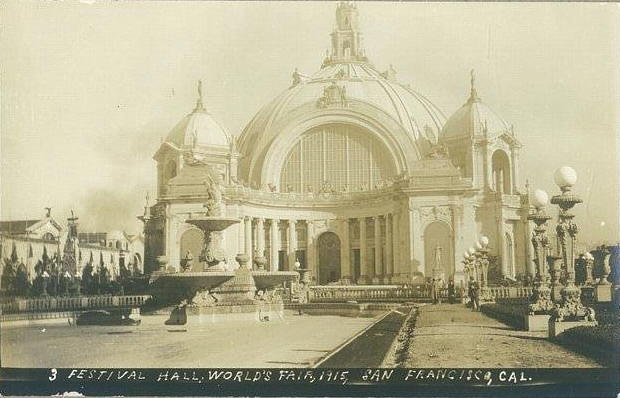
If you flew by overhead, say in a Zeppelin, you’d see an impressive city of domes, gargantuan in aspect and harmonious in coloring. The festive avenues are lined with full-grown palm and eucalyptus. The Palace of Fine Arts is swathed in creeping vines and bordered by the finished lagoon, looking like it’s been there a thousand years. You might land to the northeast, where the aeroplanes land, or come in by yacht, docking at the marina. Perhaps you’ll just drop from the sky, piercing the thin plaster of the Dome of the Ages, breaking your limbs and revealing the flimsy wood lathing that supports these impostors.

The Festival Hall at the Pan Pacific World's Fair from an unmailed postcard

The Festival Hall at the Pan Pacific World’s Fair from an unmailed postcard

It was easier to participate in the suspension of disbelief at night, when the Scintilators played their “curtains of color across the black sky above the bay,” the drunken revelers in the Zone would be reeling around, and music and gaiety everywhere suffused the atmosphere. Then it would be as if one had been transported magically to a place where the glorious past and the tantalizing future had merged into one delightful confection; hope, memory, and the whirl of the present fused together mystically and maniacally. Max writes of the Fair at night, walking down the Avenue of Progress toward the water that, “Bright banners hung high the whole length of the avenue, beating about in the wind, casting shadows into stray clouds of steam. They looked like lurid poppies floating in a black pool, all poked and pushed by drunken fish, jumping around there in the night. I got to feeling dizzy, what with the long avenue leading off into infinity and the sky displaced by so many colors.”

Matthew Stadler’s Landscape: Memory would surely benefit from a more thorough analysis. I have failed to touch on themes from Ruskin that surface throughout the book and further inform the narrative and the understanding of the landscape. There are many more than passing mentions of the feel of the sea breeze, the wheeling of gulls, the sensation of dewy grass against the calves, and of course the whole gay erotic subtext of the book that informs an entirely different sort of landscape—that of desire. I have, however, attempted to show the power that landscape has for the knitting together of narrative and setting and its capacity for establishing and enabling theme. I have also tried to show that literature is an excellent reference to the subjective experience of landscape; that to ignore the ever-shifting and multi-sensory aspects of it as exposed by writers is to miss the greatest opportunity for designers of the landscape—mastering the evanescent qualities of plants, sky, sun and moon, and the ephemeral motion of people and animals through them.


London Doesn’t Need a Garden Bridge

by Tim-Waterman on December 3, 2014, no comments

A friend told me a story recently about an urban designer who derided a landscape architect with whom he was working for not understanding urban design because his insistence on planting shrubs was in clear violation of the principles of ‘designing out crime.’ Designing out crime is a tick-box approach to urban design that will always shun the shrub as it is seen to provide a refuge for lurking criminals. Please ignore the fact that the lurking criminal is probably just a homeless person seeking a place to sleep and focus instead on the urban designer’s prejudices. His problem is that he views urban design not as a conversation between professionals and communities with different capabilities and perspectives, but as a work in which prescriptive principles, in the hands of a master designer (him), can, with great certainty, assure the success of a particular piece of design.

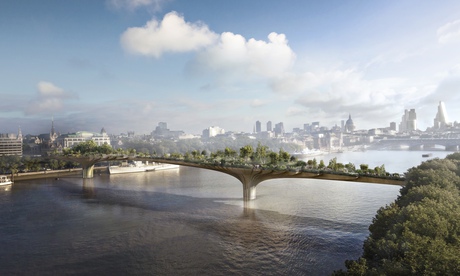
Two master designers are at present seeking to commit an expensive act of vandalism on London’s River Thames, and have just been given the green light by the two London Boroughs upon whose banks the bridge will rest.  Thomas Heatherwick designs beautiful toys and Dan Pearson designs beautiful plantings, but together they have wrought a beautiful disaster. Its construction is based upon the erroneous prescriptive principle that an ‘iconic’ structure is always a benefit – as if headlines alone will make a great city or a great nation. It only remains for London’s Narcissist-in-Chief Boris Johnson to wave it through – and self-aggrandizement through the construction of a useless bit of iconic bling is something he craves. Just look at that awful loopy red thing on the Olympic site in Stratford, for example.

The Garden Bridge (eventually to become the BP Garden Bridge or the Virgin Garden Bridge, certainly) will be a fitting icon. It will stand as a symbol of the corruption, greed, and narrow-mindedness of contemporary political, corporate, and urban (just try to separate them) processes. Our government’s greater act of vandalism, that of eviscerating higher education and the rest of the public sector in Britain, will need memorializing. What more fitting monument than a symbol of a lack of holistic and critical thinking in London and lavish spending on a project to benefit a central few rather than the many neighbourhoods (and many small landscape architectural practices) that could benefit so much from a fraction of that cash. We’ll have higher education only for an elite, we’ll have a bankrupt NHS, we’ll have rampant homelessness, but hey, we’ll have a garden bridge.

London's proposed Garden Bridge. Image by Arup - source Wikimedia.

London’s proposed Garden Bridge. Image by Arup – source Wikimedia.

When a landscape architect plants a shrub, it may indeed be in the knowledge that a homeless person might find refuge there. It may also be to slow stormwater runoff in order to prevent flooding downstream. It might also be for beauty and pleasure. This is the real meaning of green infrastructure. The garden bridge is vain greenwash. We need generosity and openness in our cities. We need to have urban designers and politicians who are engaged in meaningful conversations with each other and with places, not peddlers of ego and of false certainties. The garden bridge is a fine symbol of how sick and selfish we’ve become. London doesn’t need a garden bridge.

A Word … “Work”

by Tim-Waterman on November 29, 2014, no comments

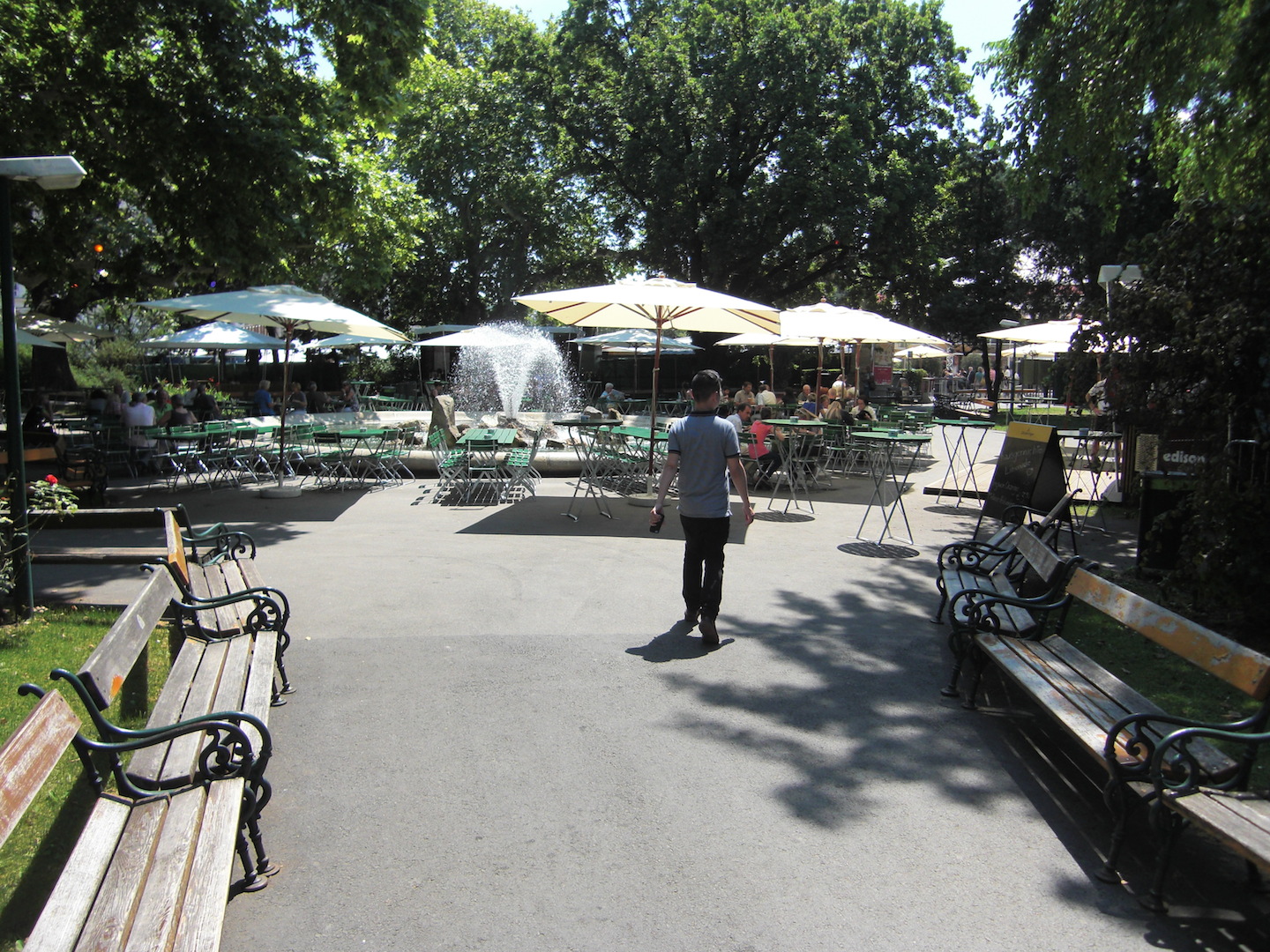
A stroll in Vienna's Rathausplatz garden. Designing for this kind of leisure, pleasure, and play is anything but a 'bullshit job.' Photo by author

A stroll in Vienna’s Rathausplatz garden. Designing for this kind of leisure, pleasure, and play is anything but a ‘bullshit job.’ Photo by author

“A Word …” is my quarterly column for Landscape: The Journal of the Landscape Institute. Here in the Winter 2014 issue I argue for a better work/life balance for landscape architects.

Ebenezer Howard, the father of the garden city, whose diagrams of garden city relationships of 1898 have consistently been mistaken for blueprints ever since, would, were he alive today, be aghast at both that fact and at the fact that we have fallen so far short of the ideal social relationships that he envisioned as well. Howard was a radical with a keen sense of social justice, who believed that people should be in charge of their own environments and their own destinies, and that they had a right to do meaningful work that would benefit themselves, their families, their communities, and the natural world around them. Listen to his tub-thumping tone here: “The true remedy for capitalist oppression where it exists, is not the strike of no work, but the strike of true work, and against this last blow the oppressor has no weapon.” He meant both the work of the traditional workplace, and also the work that we do as part of our communities to build a better world together.

Most who work in the landscape professions can actually lay claim to doing true work that makes an actual difference, a rarity in this age where many people work what anthropologist David Graeber has called ‘bullshit jobs’ (such as telemarketers, corporate lawyers, or people suspended in the middle of vast bureaucratic structures who can see for themselves that their work is meaningless). In order for these people to have self worth in such jobs, society has been restructured such that the value of work is in the act of work, and not in that value created from it. In this skewed world, someone who works fifty hours a week producing nothing has greater value than someone who works a few hours a week producing something that makes the world a better place, such as beautifully illustrated children’s books or solar panels or delicious pies. Graeber believes we should judge the value of labour by how well it cares for people rather than by any other conventional measure.

This attitude of work-for-work’s-sake means a few rather dreadful and dangerous things for designers. First, because the work of design is both enjoyable and can produce things that make the world a better place, it is suspect. You shouldn’t enjoy your work, and if you do, you should be paid less. People who genuinely do good things in the world are often paid a pittance – care-givers, teachers, artists, designers. Second, the creative lives of creative people are now governed by an insane work ethic that keeps them in their desks for fearfully long hours, despite the fact that creative work requires copious quantities of down time, thinking time, and lots and lots of time to make mistakes and learn from them.

Finally, and I think this might be the most damaging consequence of long working hours in design – particularly landscape design – is that everyone is working so hard that they have forgotten how to live, how to relax, and how to enjoy those spaces that they are straining themselves to design. You wouldn’t ask someone who never eats delicious pies to make some for you any more than you would ask someone with no experience of leisure to design the places you need for fun and conviviality.

So, next time you find yourself in the office at 8pm do yourself and everyone else a favour and leave. Go to the pub – no, better yet go to the park. Live a little, relax a little, and then when you go back to work what you do will be all the more meaningful for it. Strike a blow at those capitalist oppressors by doing a lot more true work -and stand up for your right to work and be compensated for something that’s not a bullshit job.

A Word … “Landmark”

by Tim-Waterman on September 16, 2014, no comments

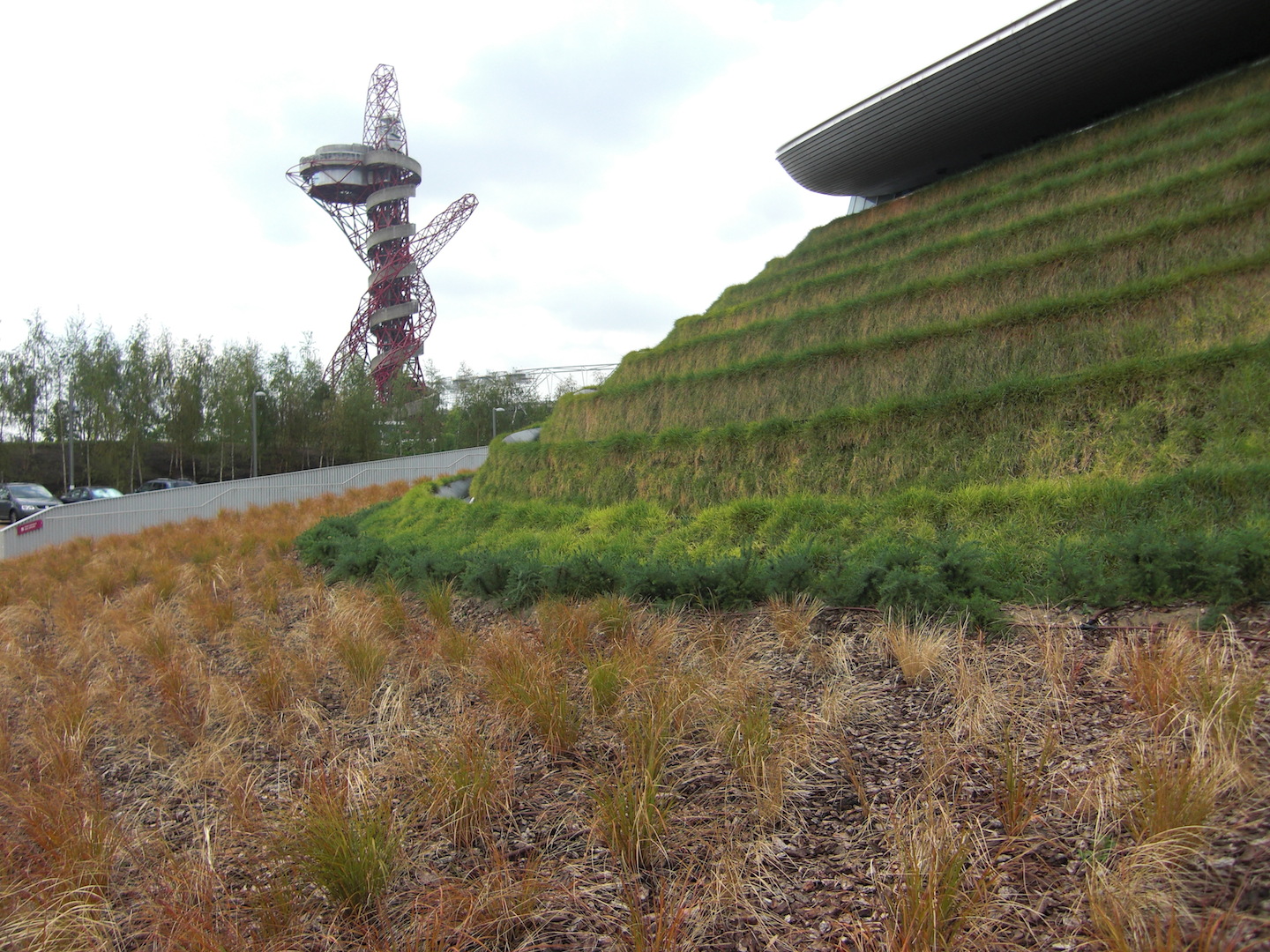
"... that awful loopy red thing" at the site of the 2012 Olympic and Paralympic games.

“… that awful loopy red thing” – The Orbit – at the site of the 2012 Olympic and Paralympic games in London’s Stratford.

“A Word …” is my quarterly column for Landscape: The Journal of the Landscape Institute. Here in the Autumn 2014 issue I demolish a couple of Norman Foster buildings and “…that awful loopy red thing”. 

Our cities are places defined by what the architectural historian Spiro Kostof called ‘a certain energised crowding’. This is an understated way of describing the intoxicating density and intensity of action, interaction, and spectacle that defines the urban experience. The fine-grained texture of our cities, though, is not one of continuous hyper-stimulation. Even in the wealthiest and most congested city centres, where the greatest number of buildings and other elements of urban topography vie for attention, there are still calm and dignified stretches of unified cityscape.

The same concentration of totemic features that many cities display is evident in the design of theme parks, which are typically a dizzying mishmash of emblematic structures, logos, and loaded imagery. The back of one attraction is the front of another, and no matter which way one turns there is a landmark loaded with signification. This way Paris, that way Venice, over here Tomorrowland, and here dinosaurs grazing in primordial swamps. Both cities and theme parks overload the senses, resulting in an intoxication that can be euphoric or disorientating or both. Each requires an eventual escape. With a theme park this is a simple matter of finding the exit, but with a city those mechanisms for release must be found within. The city as a whole cannot be constantly and everywhere in a state
of climax.

Landscape architects, within planning processes in urban design, need to be constantly vigilant to carefully moderate the urges of both clients and of building architects to make every edifice a monument or a logo. Even the most celebrated architects are guilty of designing objects displayed on plinths that are utterly acontextual. When a number of such buildings are crammed together, as they are in such orgies of bling as Dubai, the overall effect is camp writ large – as though every street corner were one of Liberace’s extravagantly jewelled knuckles.

A good landmark, whether a building, a sculpture, or a feature within a park, should be of its place and for its place, or perhaps in radical contrast to its place; but overall the effect should be to punctuate and to anchor. In striving for logo buildings many architects have gone too far and plugged up a landscape with buildings like bungs. Foster’s London City Hall and his Sage in Gateshead are both rounded in plan and section and both are designed as though on plinths. Neither building will allow for the city to flex and change around it. Neither, I would imagine, will still be standing in twenty years’ time. Neither is as much a landmark, a marker of place, as it is a monument to itself. Rather than the grain of sand that forms a pearl, each is an irritating foreign body that will eventually be rejected.

Note how I’ve mixed my metaphors? I have bungs and corks, sand and pearls, orgies and jewels and knuckles. I’ve spangled this column with the same sort of overwrought conceptualism that is so problematic in our cities. There are places, though, where this approach can actually work. This is in a park where many conceptual structures can be a collection of follies. London’s Olympic Park is a good example, where a stadium, a ‘wave’, a ‘Pringle’ and that awful loopy red thing all conspire to provide an exquisite balance between theme park and peaceful haven, reinventing the grand tradition of Stowe, Stourhead, Castle Howard, and Kew. Kew has only preserved a fraction of the number of follies it had when it was built (there were once fully twenty classical temples), so there is comfort that Stratford’s ensemble will still have integrity when the Orbit is demolished.

Joined-up Thinking

by Tim-Waterman on September 16, 2014, no comments

This is an article that appeared in last month’s Garden Design Journal in their ‘Talking Point’ opinion section. 

I love to travel by train, because of certain negatives – because I hate car traffic and airports and because I’m too tall to fit into the aeroplane seats that I can afford. There are also distinct positives, such as the ability to watch the gradual changes in the landscape between cities, to have the luxury of time to contemplate those changes, and also to peer into so many back gardens. The orderly world of the surveyor’s geometry is often quite obscured, and all of the different scales at which the landscape professions operate are possible to easily comprehend from the train, nested into one another. Buildings, too, are viewed differently from the train, as their frontages rarely face the rails. All of the lumpy structures that accommodate the lives we actually live, rather than the face we show the world, are in evidence in the view from the train.

These higgledy-piggledy back alley perspectives, seen through murky windows, also serve as an allegory for the interrelationship of the landscape professions. Connections are haphazard, boundaries are unclear, some areas are derelict because no one can figure out how to put them to profitable use, but still the whole messy ensemble somehow manages to form a coherent setting in which people are able to operate more or less effectively.

Garden designers, landscape architects, planners, and architects all manage to get on with their jobs despite the disputes at the boundaries and the prejudices and misconceptions that we hold regarding each other’s work. Our relations could be so much better, though, and perhaps the way to this is to ask what the landscape needs rather than what our professions need – and what we need to know to work with it. This requires framing our knowledge carefully so that we help each other to understand all the various elements of landscape work. Some of these elements are obviously shared and fun to talk about, like plants, but other issues are more convoluted and difficult – issues of society and communities, class, the construction of green infrastructure, public and private space, and so on.

I had hoped, when I began to write this piece, that I could demonstrate that what divides landscape architects and garden designers is not scale, or plants, or any particular, but rather that garden designers work largely for private, often wealthy clients, whereas landscape architects tend to be employed on public projects. Simple. Garden designers are right wing, landscape architects are left wing, and never the twain shall meet. The desire, however, to make a simplistic and provocative point that might raise a few hackles and start a few conversations, is thwarted by the fact that this simply isn’t the case.

I have come to realise that the greatest divides between professions of all sorts (the divide between landscape architecture and garden design is merely typical) are caused by the fact that all we understand how to do what we do, but few are able to put their work in context in the broadest terms of geography, history, politics, and sociology alongside the scientific aspects of our work.

Neither landscape architects nor garden designers have historically been very good at thinking and writing critically and contextually about their work, but landscape architecture in Britain has been getting much better in recent years at doing so. Architects are good at criticism, but often hostile to context – and context is what they most need to come to terms with, especially in our cities.

A lack of context is what leads to assumptions such as that landscape architecture is a subset of architecture, and that garden design is a subset of landscape architecture. Certainly the areas of practice overlap, but the realms of knowledge required for each role are vast, and vastly different.

The cure for the prejudices that plague our professions and hamper our work lives would begin in education. Architects need to be taught not just by architects, but by garden designers, landscape architects, civil engineers, planners, and so on. And the same is true in any other combination. We can’t hope to understand each other without teaching each other. Garden design has a unique situation amongst these professions in that it is most often taught on short diploma courses. We need far fewer of these very short courses and far more full degrees in garden design, and all the way to Master’s level. We must take garden design as seriously as we take landscape architecture and expect practitioners to be as highly qualified.

Finally we need far better communication and collaboration between our institutions in order to protect and promote all land-based work because it is all under threat. Landscape management has all but disappeared, for example, and it needs the combined might of  the whole sector to rectify this problem. Highly skilled horticulturists are often treated – and paid like – unskilled labour, which again is a tragedy, but also a problem for all of us and for the landscape. We must put our collective energies to solving this problem.

Those of us who work on the land are all part of the same murky picture, and we must begin working towards bringing that picture into focus in education, in our institutions, in our collaborations, and in government policy.

Through landscape our professions have immense power to re-envision the practice of everyday life to effect more sustainable human behaviour and habits of occupation and land use. This is why it is powerfully important that garden design is treated as both an intellectual and an instrumental profession, and one that operates alongside architecture and landscape architecture as a natural equal – and all of these professions has considerable work to do to make that happen.